
The best sliding closet doors are the ones that let you use the planned storage comfortably and suit the room's visual and care requirements. Begin with the drawers, shelves and hanging areas behind the doors, then choose a compatible panel and hardware system. A brand or finish alone cannot determine the best option.
This guide provides a needs-based comparison for homeowners and cabinet planners. It is not a hands-on ranking of products or a claim that one material is universally superior.
Selection order: prove useful storage access first, confirm the complete operating assembly, then compare appearance, maintenance and the full supplied scope.
Start with the storage movements
Draw each drawer, pull-out basket and hanging section behind the proposed door positions. Include the space needed to remove larger stored items, not just the closed cabinet front.
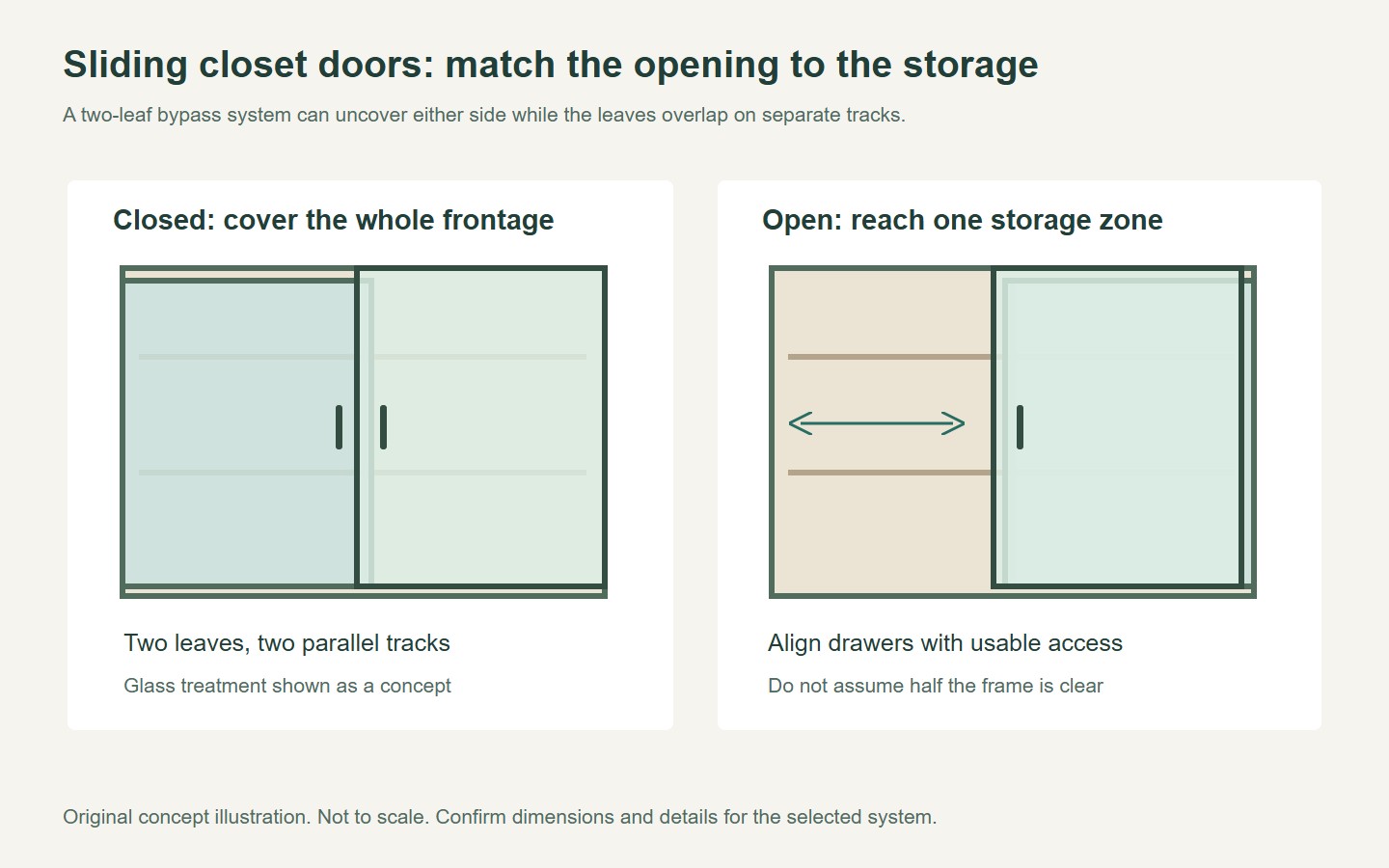
Ask for the actual clear access in every relevant open position. Overlapping panels may leave part of the closet covered, and more leaves do not automatically provide full-width simultaneous access.
Check the approach in front of the closet with beds, tables or other furniture in place. A door that slides smoothly can still be inconvenient if a user cannot stand comfortably at the accessible section.
Eliminate configurations that fail an essential storage movement before comparing decorative finishes. Resolve the cabinet and door layout together rather than relying on later adjustments to create missing access.
Choose a face material for a specific need
Compare the actual visual purpose of the door. An opaque face conceals the contents, a mirror adds a reflective surface and a translucent infill creates a different relationship with lighting and stored items.
| Priority | Candidate approach to evaluate |
|---|---|
| Conceal busy storage | Suitable opaque panel with approved finish |
| Provide a dressing reflection | Documented mirror-door assembly |
| Soften the visual boundary | Translucent sample reviewed against actual contents |
| Coordinate with joinery | Face pattern and finish approved with nearby materials |
Contractors Wardrobe describes a specific prefinished panel-and-frame construction in its Colonial range. Use a product's actual material description rather than treating its style name as the specification for all comparable doors.
Match the complete leaves to the hardware
Confirm finished dimensions, thickness, weight and suitable fixing areas. Include mirrors or added faces in the completed leaf rather than selecting hardware from the core alone.
Hettich TopLine XL is an identified top-running cabinet-door system. Its components and requirements belong to that system; a general hanging-door description does not establish compatibility with any leaf or support.
Ask for the required lower guides, stops, handles and selected closing options in the parts list. A visually discreet component may still be essential to the approved movement.
Review appearance and care in the room
Place samples beside the room finishes and view them under daylight and normal evening lighting. For mirrors, check the reflected scene from the bed, entrance and dressing position.
AGC Mirox documentation identifies specific mirror products, backing options and care requirements. Do not treat every reflective insert as having the same construction or cleaning instructions.
Ask how overlapping surfaces, tracks and guides will be reached for routine care. The best-looking option should still have a practical maintenance arrangement within the product's permitted procedure.
Keep any decorative or material change connected to the hardware review. A different face can affect the final leaf even when its outside dimensions appear unchanged.
Compare complete quotations and aftercare
Use the same opening and storage brief for each proposal. Confirm whether the quotation includes leaves, frame, track, hardware, finish, measuring and installation.
Ask who verifies the final fit if the cabinetry and doors come from different businesses. Retain the approved combined drawing and identify any exclusions or unresolved work.
- Prove access to drawers and stored items.
- Choose the face for a stated visual need.
- Confirm complete leaf and hardware compatibility.
- Check real samples and practical care.
- Compare the full supply and service scope.
For related interior solutions, view Forge interior door examples and confirm the exact closet-door requirement. The best sliding closet doors for that project will be the supported assembly that works with the storage and users, rather than an unqualified winner on a generic list.
Questions buyers ask
Which material makes the best sliding closet door?
It depends on the actual need. Compare opaque, mirrored or other suitable faces through storage access, room appearance, care and complete construction. A material label alone does not identify the best assembly for every closet.
Should I choose two or more sliding leaves?
Use the actual closet and storage layout to decide. Ask how each configuration parks and what clear access remains for drawers, baskets and larger items. More leaves do not automatically mean the whole width can be opened at once.
What should I prioritise over the door's appearance?
Essential storage access and compatible operation should be established first. Confirm the completed leaf, supporting system and required components, then compare real finish samples, cleaning access and the complete quotation scope.
Prepared for Forge Windows and Doors (FoShan) Co., Ltd. Sources checked . Catalogue photographs and planning illustrations do not establish the performance of a supplied product.


