
A deadbolt for a sliding patio door must be suitable for the sliding assembly and its receiver. Do not assume a conventional swinging-door deadbolt fits simply because it uses a key or has a familiar body shape. Confirm the actual mechanism, door preparation and operation from both sides before ordering.
For homeowners considering a new lock or retrofit, begin with the door and existing hardware identity. The lock, frame, glazing and related components form a complete opening; one added part does not establish a new security rating for the whole assembly.
Selection brief: identify the supported locking mechanism, compatible receiver and required access and release function for the actual patio door.
Distinguish sliding and swinging applications
A lock's intended application matters because the door and receiver move relative to each other in different ways. The product documentation should identify which version suits the proposed opening.
Adams Rite distinguishes straight-bolt and hookbolt variants in its MS1950P family, with the identified hookbolt version intended for sliding applications. This is a specific manufacturer example, not a universal recommendation for all residential patio doors.
Ask the supplier to confirm the exact product and version. A shared family name or finish does not make every variant suitable for the same frame or preparation.
Do not copy dimensions or fitting details from another lock because its appearance is similar. The proposed body, receiver and operating components need to be reviewed together.
Identify the existing door and replacement scope
Collect accessible product labels, original order information and photographs of the opening and lock area. State whether you want to replace an existing component or add a new authorised access function.
Andersen documents exterior keyed options for particular gliding patio-door series. This illustrates a manufacturer-supported accessory route that depends on the actual door, rather than a generic deadbolt retrofit.
| Enquiry field | What to confirm |
|---|---|
| Door identity | Manufacturer, series and existing arrangement |
| Lock scope | Cylinder, accessory, main mechanism or complete assembly |
| Receiver and preparation | Supported parts and fitting requirements |
| Required function | Normal authorised use from both sides |
Have the provider identify the compatible solution before parts are purchased or physical alterations are approved.
Review preparation and the complete assembly
Ask which parts of the leaf or frame would be changed and whether the work follows an approved instruction for the actual product. Confirm suitable fixing areas and clearance from glazing and moving components.
Where glass preparation is involved, the National Glass Association engineering manual explains why fabrication of tempered glass must be completed before heat treatment. Later drilling is not a routine method of adapting an existing tempered pane to a new lock.
If the existing door binds or the receiver does not align, arrange assessment of that condition. Adding a different deadbolt should not be treated as a way to conceal an unresolved operating or frame problem.
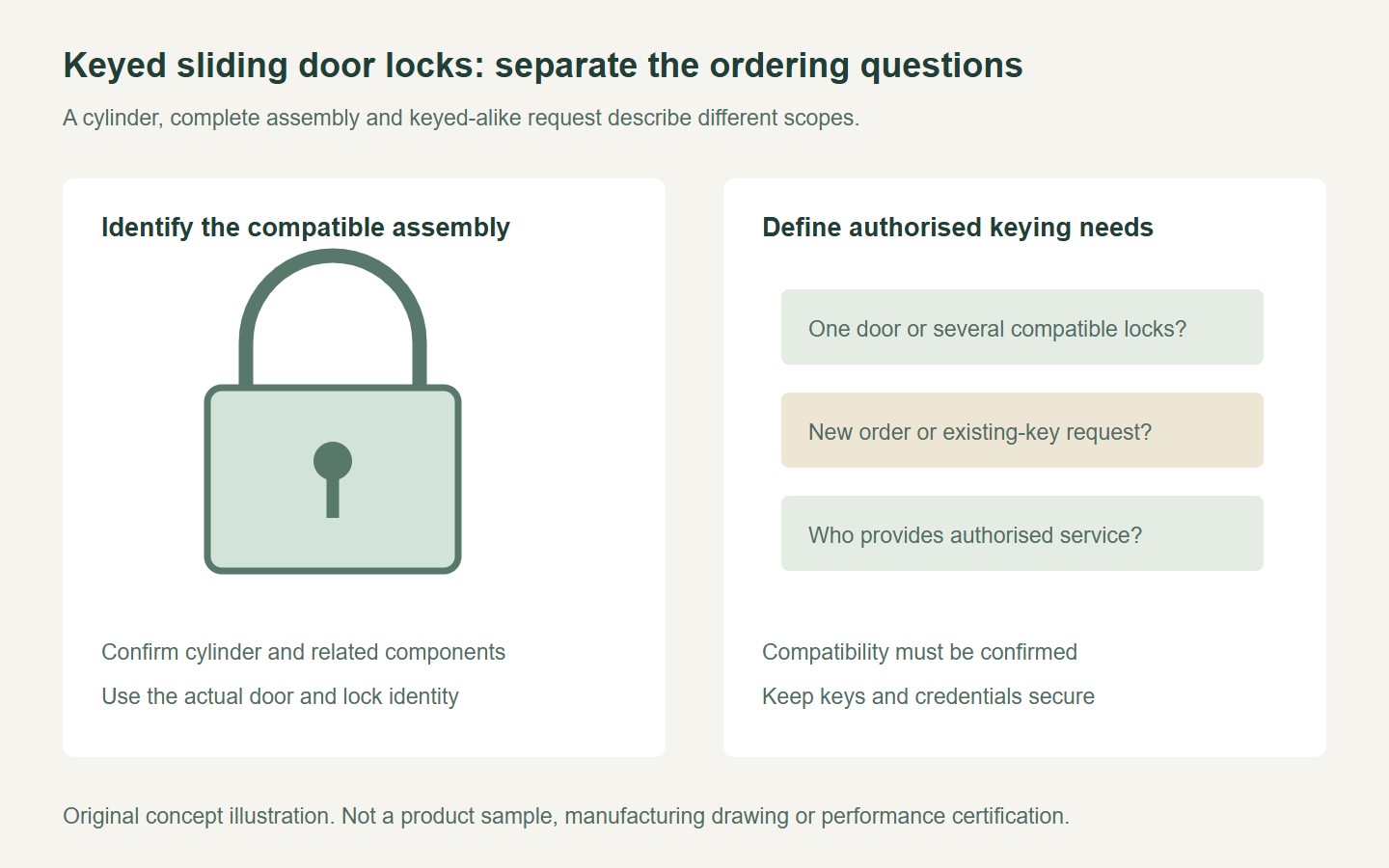
Confirm access, release and the intended use
Ask how the proposed arrangement is locked and released during normal use. Consider the actual users and any required passage or building function before selecting the hardware.
A keyed component or additional locking point should not be added without understanding its effect on operation from each side. Have the appropriate professional review any special requirements for the opening.
Keep security claims tied to relevant evidence for the complete proposed configuration. A lock manufacturer's description of one component should not become an unsupported claim about the entire door, glazing and installation.
Store keys and sensitive access information securely. Ordinary project drawings can identify the responsible owner and service provider without containing credentials or instructions that enable unauthorised entry.
Retain the supported parts and service record
Request a written scope for the confirmed product, required preparation and installation work. Record who accepts responsibility for compatibility and for any related repair found during assessment.
At handover, obtain a demonstration of normal authorised operation and the care instructions for the actual assembly. Keep the installed part references with the original door information.
- Identify the correct sliding-door application.
- Confirm the door and lock replacement scope.
- Review preparation and compatible components.
- Check access and required release.
- Retain the installed-product and service record.
For a Forge door, send the order reference and requested locking function for review. The sliding door catalogue does not establish compatibility with every deadbolt. The right choice is a supported, documented locking arrangement for the actual patio assembly.
Questions buyers ask
Can I fit a normal swinging-door deadbolt to a sliding patio door?
Do not assume it is suitable. Sliding applications need a compatible mechanism, receiver and preparation for the actual door. Identify the product and ask the supplier or qualified provider to confirm an appropriate supported arrangement before alteration.
Does a hookbolt fit every sliding door?
No. A hook-shaped bolt is only one characteristic of a particular lock. The body, receiver, frame, preparation and required operation must all be compatible. Use the exact product version and door information rather than choosing from the bolt shape alone.
Will adding a deadbolt guarantee a secure patio opening?
No universal guarantee follows from one component. Glazing, frame, receiver, hardware, installation and required operation form the complete assembly. Request evidence relevant to the proposed configuration and have compatibility and use assessed appropriately.
Prepared for Forge Windows and Doors (FoShan) Co., Ltd. Sources checked . Catalogue photographs and planning illustrations do not establish the performance of a supplied product.


