
Door locks for sliding glass doors should be selected by the actual door construction and application. A framed residential patio door, an interior glass leaf and a narrow-stile commercial entrance can need different locking arrangements. Match the lock, receiver, preparation and required operating function to the identified system.
The phrase glass door describes the visible infill more clearly than the mounting details. Before choosing a lock, identify what supports it and which part it engages when the door closes.
Selection method: establish the door type and function, then confirm a compatible complete locking arrangement rather than choosing by the keyhole or handle appearance.
Classify the door before comparing door locks for sliding glass doors
Record whether the glass is held within a framed leaf or forms part of a different interior system. Identify the manufacturer and model where possible.
For a patio assembly, use the actual product's service and accessory information. Andersen describes exterior keyed-lock options by gliding-door series, including compatibility and handing considerations.
For an interior glass system, dormakaba describes configurable locking options within its MUTO range. Those belong to a named interior assembly and should not be treated as interchangeable exterior patio locks.
Keep the normal application clear. A product designed for one type of frame or leaf cannot be assumed suitable for another merely because both openings use glass.
Specify the required closing and access function
Describe how the door should be used from each side. Distinguish a simple pull or latch, privacy operation, exterior keyed access and any other required function.
Identify the components that carry out that function. A handle, cylinder, locking mechanism and receiver may be separate items in the supply package.
Andersen separates certain handle hardware from its associated lock and receiver parts. Read the actual contents rather than assuming a handle set includes every item required to secure the opening.
| Requirement | Question for the supplier |
|---|---|
| Normal closing | Which mechanism holds or locks the leaf? |
| Authorised access | How is it operated from each required side? |
| Receiver | Which compatible component engages the lock? |
| Package | What is included and what is separately supplied? |
| Required building function | Does the configuration preserve applicable access needs? |
Match preparation and geometry to the actual product
Provide the leaf or stile material, relevant thickness and existing preparation. Record handing and the closing relationship with the frame or adjacent panel.
Adams Rite identifies a hookbolt variant for specific narrow-stile sliding-door applications. That named arrangement demonstrates why bolt and receiver geometry matter; it is not a universal replacement for every residential slider.
Ask for the exact compatible part references and preparation instructions. Do not drill a generic pattern into glass or an unidentified frame or assume one mounting dimension proves full compatibility.
Check handle and lock projection through normal movement. A component that fits when closed can still interfere with another leaf, trim or screen when the door moves.
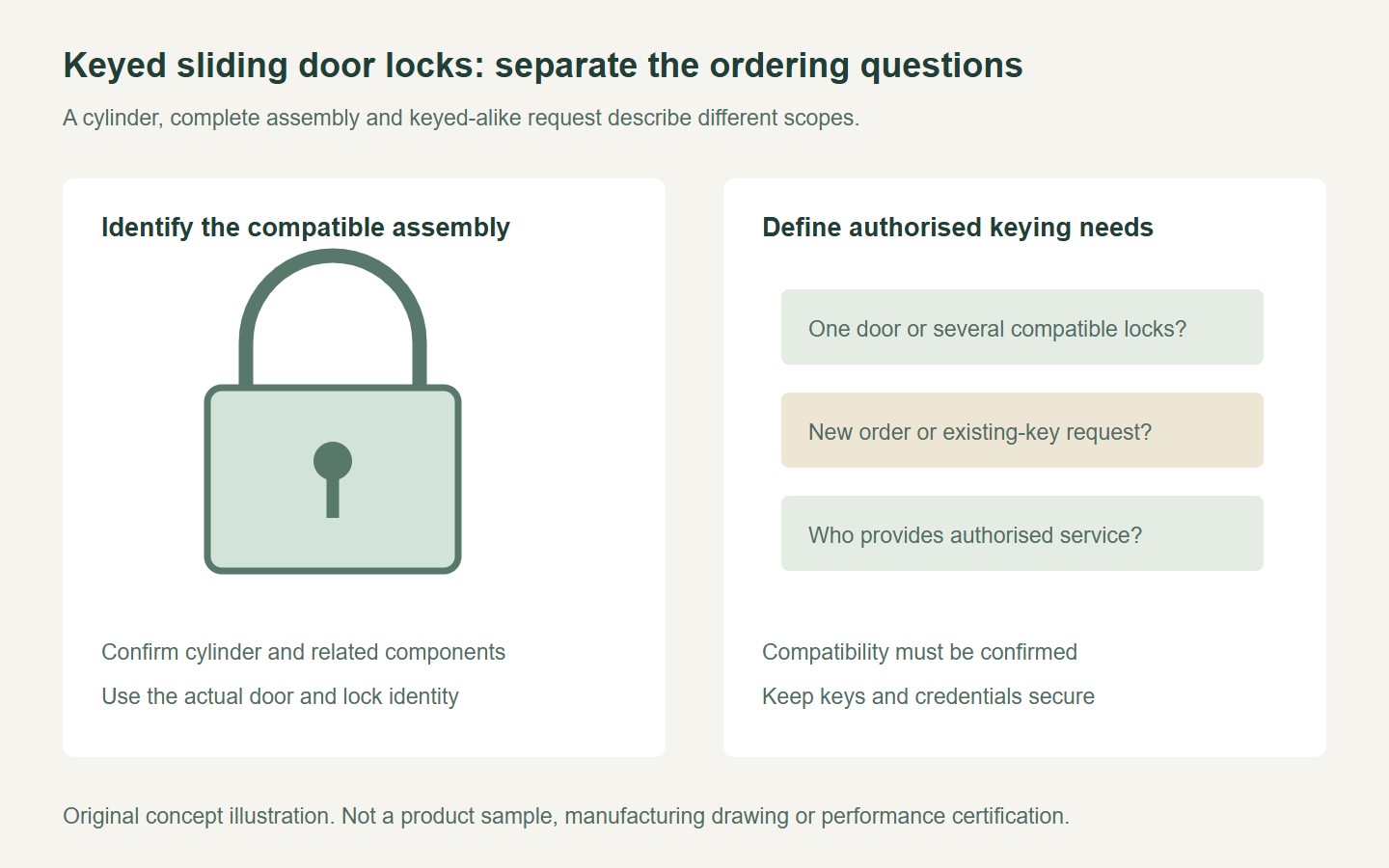
Review condition and required access before upgrading
If the existing door is difficult to close or lock, record the symptom and have the cause assessed. A replacement lock should not be used to conceal a damaged or unsuitable running assembly.
Retain required guides, stops and panel-retention components. The locking arrangement should work within the complete product rather than rely on altered movement or omitted parts.
Have any required exit or access function reviewed for the actual project before changing the hardware. A keyed option does not automatically establish that every inside operation is appropriate.
Keep the difference between lockability and a tested security outcome clear. Request relevant evidence when a particular security requirement is part of the brief, rather than relying on an impressive product name.
Verify the final combination and retain service references
Compare delivered parts with the approved order and resolve mismatches before modifying the door. Keep the actual lock, receiver and hardware references together.
At handover, obtain a demonstration of normal closing and authorised locking from the intended sides. Check unlocked movement and accessory clearance with the complete system installed.
Ask about the applicable care and service process. If operation changes, use that route instead of forcing the mechanism or improvising an adjustment from a different product's instructions.
- Identify the door construction and application.
- Define closing and access functions.
- Confirm compatible parts and preparation.
- Review condition and required building functions.
- Verify normal operation and retain the record.
For a Forge product, send the model or order details when requesting lock options. A precise enquiry helps the supplier assess the actual system instead of treating every glass-door lock listing as an equivalent choice.
Questions buyers ask
Can a lock for a frameless interior door fit a framed patio door?
Do not assume that. The leaf construction, mounting, receiver and required function can differ. Identify the actual product and obtain confirmation for a complete compatible locking arrangement.
Is a keyed handle set a complete lock package?
Not always. Handles, cylinders, mechanisms and receivers may be supplied separately. Check the actual contents and part references against the function required for the door.
What should I do if the existing door will not lock easily?
Have the door and locking arrangement assessed rather than assuming the visible lock is the only cause. Record the product and symptoms and use the appropriate service process before selecting a replacement or upgrade.
Prepared for Forge Windows and Doors (FoShan) Co., Ltd. Sources checked . Catalogue photographs and planning illustrations do not establish the performance of a supplied product.


