
A single sliding glass door usually means one moving glazed leaf, but it may be part of a larger assembly with fixed glass or surrounding framing. Define the moving leaf and the complete opening separately. Then select a suitable system for its interior or exterior role and confirm the required movement, support and glass specification.
The distinction helps when planning a room entrance or reading a patio-door quotation. A product with one active leaf does not necessarily consist of only one visible glass section, and a single replacement panel is another purchase scope again.
Brief the assembly: identify what moves, what stays fixed and where the active leaf goes when the opening is used.
Clarify the single sliding glass door description
State whether the enquiry concerns one internal glazed leaf, one operating panel in a patio assembly or a replacement leaf for an existing product. Include a drawing or product reference to remove ambiguity.
For an interior opening, a single leaf may travel along a wall or within a designed pocket. An exterior assembly needs its own frame, seals, sill and performance scope even when only one panel moves.
dormakaba describes MUTO as an interior manual sliding system with one- and two-leaf options. It also identifies configuration possibilities such as wall-pocket movement. These are named product options, not proof that any glazed leaf can be installed in any cavity.
Keep the required application clear so an interior glass system is not mistaken for an exterior patio product with different functions.
Show the complete travel and parking space
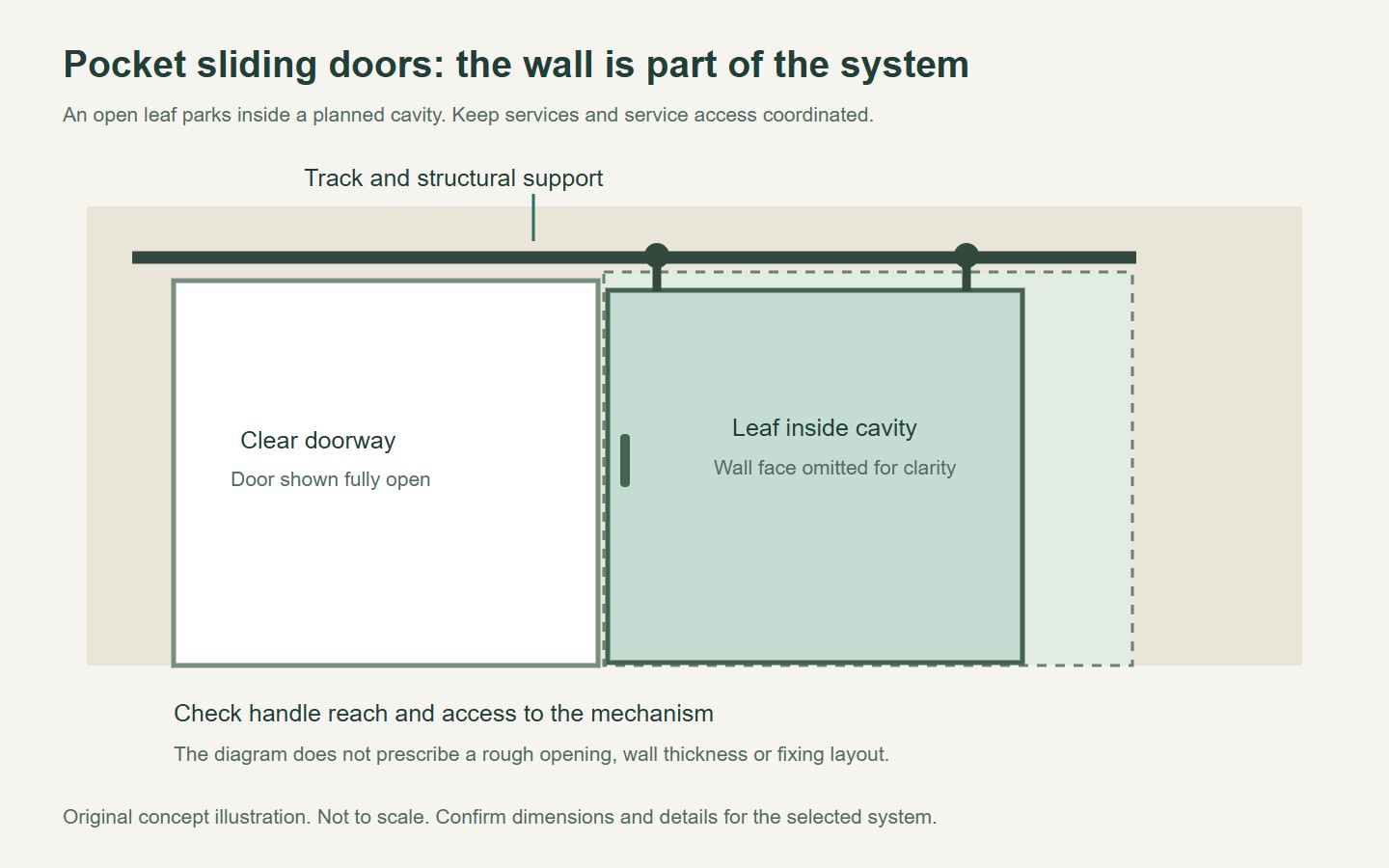
Draw the opening closed and fully open, including the handle and any fixed side glass. Mark the path taken by the moving leaf and the space it occupies when parked.
A surface-travelling leaf needs a compatible adjacent area. A pocket arrangement needs a coordinated cavity and service strategy; the wall is part of the planning even when the door disappears from view.
Review furniture, switches, coverings and other projections throughout the travel path. A single leaf can be simple to operate while still needing a carefully reserved space beside the opening.
| Assembly part | Question to resolve |
|---|---|
| Moving leaf | Actual dimensions, travel and handle position |
| Fixed surroundings | Side glass, wall or frame interfaces |
| Parking area | Surface space or designed pocket cavity |
| Useful opening | Clear passage in the approved open position |
| Service access | How the mechanism remains maintainable |
Match glass construction to the running hardware
Obtain the actual glass build, dimensions and required preparation from the selected system. The leaf and hardware must be compatible as a complete assembly.
Do not assume a thicker-looking panel or a frameless appearance establishes safety or structural suitability. The U.S. Consumer Product Safety Commission addresses architectural glazing requirements; establish the applicable project requirements and product evidence for the actual use.
Confirm any clamping, fixing, guiding and stopping requirements with the manufacturer. Keep all required retention and guidance components included, even where the design aims for a minimal appearance.
Ask for the finished leaf specification before selected closing or locking options are approved. Adding decoration, changing the glass or choosing another size can require a compatibility review rather than being treated as a purely visual change.
Review the users and required opening function
Place the handle where it can be reached in normal use and when the leaf is parked. Check the approach with the actual room layout and intended users.
The U.S. Access Board guidance considers doorway approach and operation together. Establish applicable requirements for the complete opening rather than assigning accessibility from the fact that the door slides.
For privacy, identify the needed visual screening and closing function. A clear leaf, obscured glazing and a privacy latch address different parts of the brief and should not be treated as one interchangeable feature.
Where a required exit, fire or other specialised function applies, select and document a suitable assembly through the responsible project review. One moving glass leaf does not by itself establish those capabilities.
Approve the complete installation and service record
Ask the supplier to identify the leaf, hardware, fixed surroundings and installation requirements in the proposal. Clarify whether a quoted item is a complete system or only the glass panel.
Have support, fixing and any pocket construction coordinated with the building. Plan appropriate handling of the glazing and retain the manufacturer instructions rather than improvising a release or fitting procedure.
At handover, check normal movement, authorised locking where specified and the useful passage with the finishes complete. Obtain care information for the glass, frame and hardware and keep the relevant model references.
- Define the single moving leaf and complete assembly.
- Draw travel, parking and service access.
- Verify compatible glass and hardware.
- Review approach, privacy and required functions.
- Retain the installed specification and care record.
For a single-leaf glass-door enquiry with Forge, provide the intended location and a clear plan showing any fixed glass. That allows the supplier to assess the relevant sliding door options without assuming that single describes every part of the opening.
Questions buyers ask
Does single mean there is only one glass panel?
Not necessarily. It often describes one moving leaf within an assembly that may also contain fixed glazing. Identify the active leaf, fixed surroundings and complete supply scope on the drawing or quotation.
Can a single glass leaf slide into a wall pocket?
Some specified interior systems support that arrangement, but the glass, hardware, cavity and service access must be coordinated. Do not assume any leaf can be placed in an arbitrary pocket or used outdoors.
Can I purchase only a replacement glass door leaf?
That depends on the identified existing system and compatible replacement availability. Provide the product and component references and confirm the required glass and preparation rather than ordering solely from an approximate panel size.
Prepared for Forge Windows and Doors (FoShan) Co., Ltd. Sources checked . Catalogue photographs and planning illustrations do not establish the performance of a supplied product.


