
Sliding glass door panels should arrive with enough identification to connect each component to the approved opening and glazing specification. Check the delivery records and visible condition before installation, and plan handling and storage using the correct product instructions.
This guide concerns receiving and documenting supplied panels. It is not a generic lifting, unpacking or removal procedure. Complete framed leaves and separate glazing components may require different arrangements.
Before delivery: identify who receives the order, where it can be safely handled and how discrepancies will be reported. Keep the approved drawing and supplier references available at the site.
Prepare the receiving record before the vehicle arrives
List the opening references, expected panel identities and quantities from the final order. Identify any fixed and moving leaves separately so similar-looking components are not confused.
Agree who is responsible for unloading and moving the delivery to the planned storage or installation area. The route and handling arrangements should suit the actual components rather than be improvised on arrival.
| Record field | What to enter from the actual delivery |
|---|---|
| Order and opening | Supplier reference and project opening label |
| Panel identity | Leaf position, fixed or moving role and product reference |
| Quantity | Ordered and received components |
| Visible condition | Observations and photographs where appropriate |
| Documents | Drawings, glazing information and relevant instructions |
This is a record template, not a statement of quantities or condition for any real project.
Identify sliding glass door panels consistently
Match the delivered labels to the approved drawing and component schedule. Keep the viewing direction and leaf position clear, especially where similar panels have different roles or preparation.
If identification is incomplete, contact the supplier before treating the component as interchangeable with another. A similar overall dimension is not proof of the same glazing, hardware or function.
The CPSC architectural glazing guidance identifies door applications within its U.S. safety-standard scope. Confirm the relevant glazing identification and documentation for the actual destination and assembly rather than judging safety from appearance.
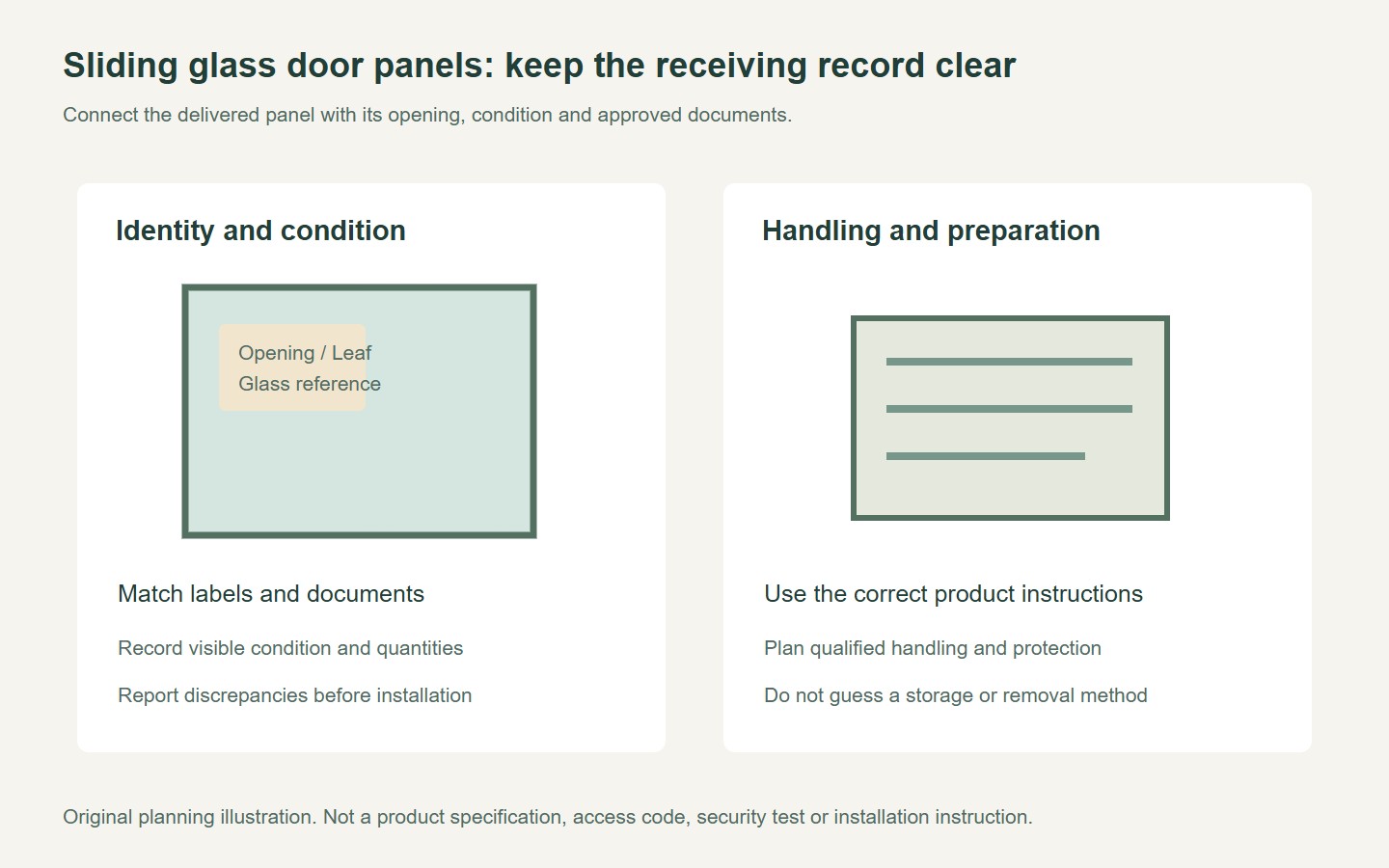
Record visible discrepancies before installation
Follow the agreed receiving process and inspect what can be assessed safely. Document apparent damage, missing components or differences from the order with clear opening references and photographs where useful.
Andersen's panel and sash storage guidance includes checking visible condition on receipt. That is a product-specific source illustrating the value of an early receiving record. Follow the actual supplier's instructions and reporting process.
Keep packaging and identifying information available as required by the agreed process. Do not hide a discrepancy by installing a component and treating it as accepted without review.
Where a concern requires further unpacking or investigation, have the responsible qualified personnel use the correct procedure. Avoid making a generic handling decision from a short online article.
Use product-specific storage and protection
Obtain the storage and handling instructions for the actual framed leaves or glass components. Do not assume that advice for timber doors, complete windows or another glazing product applies to the delivery.
Agree protection from site activity and the sequence of installation. Keep the area managed so panels are not moved repeatedly without a plan or exposed to avoidable contact during other work.
Ask which protective films or packaging elements remain in place and when they are removed. Use the supplier's instructions rather than leaving or removing a material on assumption.
The National Glass Association engineering manual explains why completed heat-treated glass should not be treated as material for later drilling or trimming. A preparation discrepancy belongs with the supplier for review, not an improvised site correction.
Carry the identification through to handover
After the appropriate receiving and installation stages, retain the final product references, drawings and relevant glazing records. They help connect a later service enquiry to the correct assembly.
- Prepare the expected panel and document list.
- Agree unloading, handling and storage responsibility.
- Match delivered identities to the approved order.
- Record and report visible discrepancies.
- Use the correct protection and installation information.
- Keep the final records for maintenance and replacement.
For a Forge order, contact Forge with the opening and order references if information is missing or differs from the approved documents. The sliding door catalogue can describe a family but cannot identify a delivered panel by itself.
Sliding glass door panels are easier to manage when identity and condition remain traceable from receipt to installation. A clear record supports the work without replacing the handling expertise the actual delivery requires.
Questions buyers ask
Can similar-looking panels be exchanged between openings?
Do not assume that they can. Check the product, glazing, preparation and panel-role references against the approved schedule, and obtain supplier confirmation if identification is uncertain.
Should I use one storage method for every door panel?
No. Follow the instructions for the actual framed leaf or glazing component and have appropriate personnel plan handling and protection. Different products may have different requirements.
What if the delivered glass has the wrong preparation?
Document the discrepancy and refer it to the supplier before installation. Do not attempt to drill or trim a finished tempered panel to make it fit changed hardware.
Prepared for Forge Windows and Doors (FoShan) Co., Ltd. Sources checked . Catalogue photographs and planning illustrations do not establish the performance of a supplied product.


