
Sliding service doors should be specified around the industrial or back-of-house task they perform. Identify the people, carts or goods using the opening, the surrounding conditions and the required closing function. A service-door label is not proof of cold-store, fire, hygiene or powered-entrance suitability.
Here, service doors refers to access between working or storage areas. The appropriate system depends on the actual use and project requirements. A residential glazed slider should not be assumed to cover that industrial scope.
Before comparing products: write an operating brief that states traffic, temperature, cleaning conditions and required evidence. Then have the relevant specialists confirm the assembly and installation responsibilities.
Describe the movement through the opening
Record what passes through the doorway and how often it is used in the normal work cycle. People carrying items, hand carts and larger equipment may create different clearance and visibility needs. Include the approach to the opening, not just its nominal width.
Identify where a sliding leaf parks and how that area is kept available. Stored goods, equipment or a change in work layout can obstruct a route that looked clear during design.
Kavidoors distinguishes an industrial sliding service-door family for defined storage and workspace applications. Its application scope is a manufacturer example, not evidence that every service slider has the same temperature or performance capability.
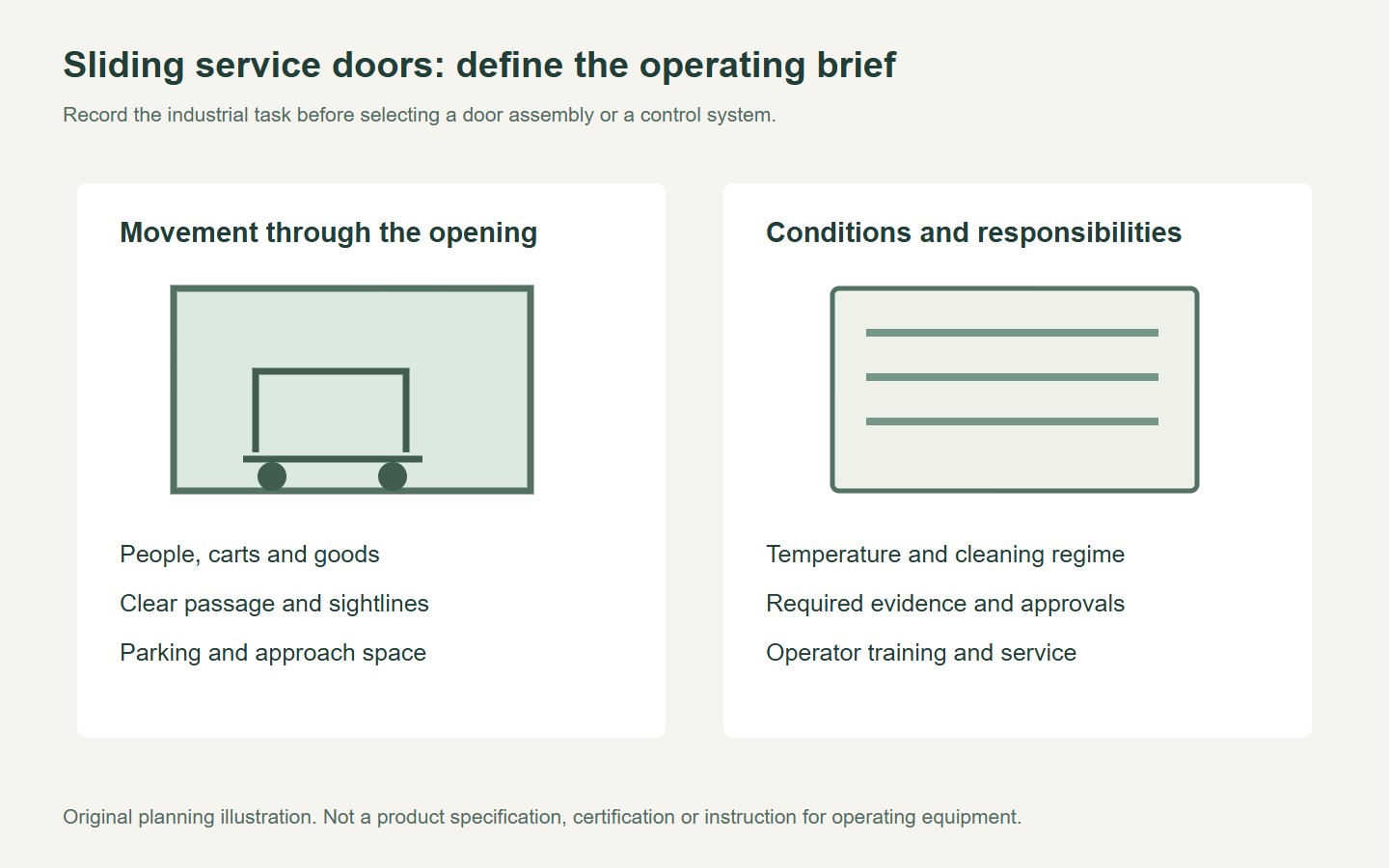
Define conditions for sliding service doors
State the operating environment rather than using a broad term such as heavy duty. Include relevant temperature conditions, moisture, cleaning methods and expected contact with goods or equipment. Ask which of those conditions the proposed system is designed to address.
| Brief item | Information to provide or request |
|---|---|
| Traffic | People, carts, goods and the required clear route |
| Environment | Temperature, moisture and other relevant exposure |
| Cleaning | Actual cleaning regime and material compatibility |
| Required function | Any separately specified fire, thermal or other performance |
| Operation | Manual or powered movement and responsible operators |
A positive-temperature service application is not the same as a freezer doorway. Likewise, a cleanable surface does not automatically establish a food-contact or hygiene certification. Match every required claim to the relevant evidence.
Coordinate access and workplace responsibilities
Have the responsible team review the doorway within the workplace route. Consider sightlines, surrounding storage, traffic separation and how the opening is managed during normal activity and maintenance.
The Health and Safety Executive workplace guidance addresses doors and traffic routes within its UK context. It illustrates why the door cannot be selected independently of the surrounding work area. Other jurisdictions require their own applicable review.
Identify any required exit or escape function separately. Do not assume a sliding service assembly fulfils that role because people can pass through it during ordinary use.
Assign responsibility for the opening support, preparation, controls where relevant and surrounding finishes. Those interfaces should be clear in the quotation and project documents.
Classify powered operation correctly
If powered movement is proposed, identify the equipment category and intended traffic. The operator, controls, protective devices and commissioning requirements need a coordinated specialist design.
AAADM lists standards for different types of powered pedestrian doors. Those categories should not be applied indiscriminately to every industrial service opening. Have the specialist determine which requirements are relevant to the actual system and use.
Discuss behaviour during a fault, power loss and maintenance isolation where those conditions apply. The work area should have an approved operating and service procedure rather than an improvised response.
Do not disable a guide, stop or protective device to accommodate traffic or make operation easier. Any proposed change belongs in the review of the complete system.
Request a complete specification and handover
The final order should identify the actual assembly, finish, hardware and required documents. Keep the operating brief linked to that specification so an offered substitution can be evaluated against the same needs.
- Record the traffic and environment.
- Confirm the required function and supporting evidence.
- Review the approach, passage and parking area.
- Identify manual or powered operating responsibilities.
- Agree installation, commissioning and staff instruction.
- Retain the care instructions and service contacts.
For a separate ordinary glazed doorway, Forge sliding door options and folding door configurations may help describe the proposed appearance. These do not establish an industrial service-door supply. Ask Forge to confirm the precise application and supply scope before treating a catalogue product as suitable.
Sliding service doors should be selected from a defined operating brief. Clear application boundaries are more useful than broad claims that one door suits every industrial environment.
Questions buyers ask
Are sliding service doors the same as cold-store doors?
Not necessarily. Identify the actual temperature conditions and the specific application supported by the proposed assembly. A service-door description alone does not establish freezer or cold-store suitability.
Does a cleanable finish prove hygiene certification?
No. Material cleanability and a particular certification or contact requirement are different matters. Request the evidence applicable to the actual claimed function and supplied product.
Can a domestic sliding door be used for an industrial service opening?
Do not assume it is suitable. The industrial traffic, environment, required functions and installation must be reviewed against the complete proposed system and relevant requirements.
Prepared for Forge Windows and Doors (FoShan) Co., Ltd. Sources checked . Catalogue photographs and planning illustrations do not establish the performance of a supplied product.


