
Space saving sliding doors remove a hinged leaf's swing from the room, but they still need a place to travel and park. Compare the complete floor plan: clear passage, usable wall, furniture access and any pocket cavity. The useful gain is improved room function, not an automatic increase in floor area.
For a small bedroom, bathroom approach or storage area, a sliding arrangement can solve a particular collision. It can also create a new restriction if the parking wall or access to a cabinet is overlooked.
Layout test: draw the existing and proposed doors with the same furniture and operating clearances, then compare what people can actually do.
Identify the problem caused by the existing swing
Mark where the hinged leaf moves and what it conflicts with. It may approach a bedside table, block a cabinet or narrow the route while another person is using the room.
Separate that movement from the space a person needs to approach and pass through the doorway. Removing the leaf swing does not remove all circulation requirements or make the full affected area available for furniture.
As a simplified geometry example, a 0.9 m leaf turning through 90 degrees sweeps a quarter-circle with area about 0.64 m²: π × 0.9² ÷ 4. This is an illustrative swept region, not measured usable floor space gained by changing a door.
Use the example only to understand movement. Actual hinges, opening angle, handles and approach needs vary, and a design decision should be based on the real room rather than a generic area-saving claim.
Choose where the sliding leaf will park
A surface-mounted leaf travels beside the opening and requires the relevant wall face to remain clear. A pocket arrangement moves into a planned cavity within the wall construction. A bypass arrangement uses overlapping leaves and provides a different pattern of access.
The Johnson wall-mount hardware range and Johnson 1500HD pocket-frame system illustrate different system categories. Obtain the actual dimensions and requirements for the chosen product rather than mixing details from separate systems.
| Arrangement | Space to reserve |
|---|---|
| Surface sliding | Wall-face travel, handle clearance and support |
| Pocket sliding | Planned cavity, coordinated services and service access |
| Bypass | Parallel panel paths and usable access behind them |
The best option depends on the conflict being solved. A clear floor beside the doorway is only one part of the comparison.
Test furniture and storage in the same drawing
Place the furniture back into both versions of the plan. Include the movement of drawers, wardrobe fronts and any nearby door, not just their closed outlines.
Check the route to the bed, basin, desk or storage while the sliding leaf is open and closed. A parking wall may prevent the position of a switch, artwork or furniture that was available with the hinged arrangement.
For a pocket door, coordinate any proposed wall-mounted item with the pocket construction. Ask the designer and supplier where fixings and services may be placed; do not assume the wall face behaves like an ordinary uninterrupted wall.
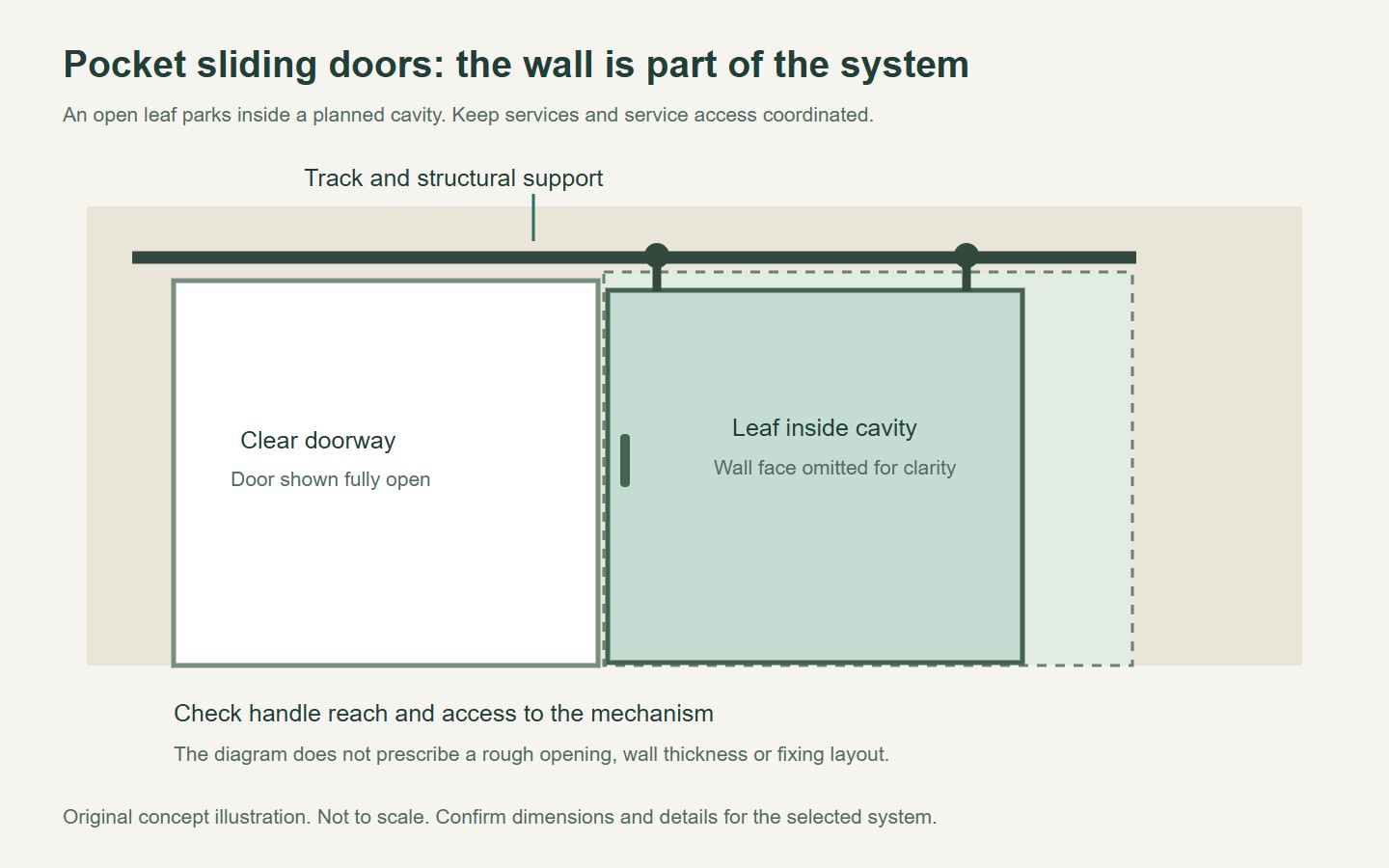
Keep passage and operation usable
Ask for the actual clear opening with the chosen handles, stops and parked position. The nominal leaf or frame size does not necessarily equal the route available to the user.
The U.S. Access Board guidance shows that accessible doorway design includes approach, operation and thresholds as well as clear width. Establish the requirements relevant to the project before treating a sliding arrangement as automatically accessible.
Check whether users can reach a recessed or pocketed pull and operate the leaf without awkward movement. A handle chosen to maximise concealment still has to work for the people using it.
Keep the required room function visible in the comparison. Visual privacy, sound expectations and any special building role should be reviewed separately; saving a swing does not justify losing an essential function of the existing boundary.
Compare the practical result and construction scope
Record the problem solved by each option in plain language: a drawer now opens, two routes no longer collide or a bedside position becomes usable. Avoid claiming a percentage increase in room size when the change is really a circulation improvement.
Include the construction and aftercare implications. A pocket conversion may involve changes to the wall, while a surface system needs the appropriate support and clear wall face. Ask who assesses and completes that work.
- Draw the original swing and actual conflict.
- Reserve the sliding travel and parking area.
- Test furniture and storage movements.
- Confirm passage, hardware and room function.
- Compare the complete installation scope.
Review Forge sliding door options with the room plan and ask for a configuration review. Space saving sliding doors are successful when the proposed plan works better for everyday use and the selected system fits its construction.
Questions buyers ask
How much floor space does a sliding door save?
There is no universal usable-area figure. It removes the hinged leaf swing but still requires approach, passage and parking space. Compare the actual room plans with furniture and storage movements included, and describe the practical improvement rather than promising extra floor area.
Is a pocket door always the best choice for a small room?
Not necessarily. It requires a suitable planned cavity and coordination with structure, services and maintenance access. Compare it with a surface or other arrangement using the full room layout and construction scope, rather than choosing only by room size.
Can I use the wall beside a surface sliding door for furniture?
Check the actual leaf path, handle projection and clearances first. Furniture or wall items may obstruct the parking area or operation. Show them on the supplier layout and obtain confirmation before assuming that wall remains available for ordinary use.
Prepared for Forge Windows and Doors (FoShan) Co., Ltd. Sources checked . Catalogue photographs and planning illustrations do not establish the performance of a supplied product.


