
Types of sliding glass door locks are best compared by the job each component performs. The main locking mechanism, an exterior keyed accessory, an auxiliary lock and a keypad or connected control are different layers of the assembly. They are not necessarily interchangeable alternatives.
For homeowners choosing a new door or reviewing an existing one, start with the actual door identity and required operation from both sides. A familiar lock shape or access feature does not establish that a component fits the leaf, frame and receiver.
Selection order: identify the main mechanism, define authorised access and release, then assess any compatible accessory through the complete system.
Start with the main closing and locking mechanism
Identify the mechanism that engages with the frame or receiver when the door is closed. Its form and operation should be documented for the actual product rather than selected from a generic appearance.
Adams Rite distinguishes locking products for particular applications. A hook-bolt or another mechanism should be assessed against its intended door and interface, not treated as a universal sliding-door solution.
Some systems use more than one locking point, but that description alone does not establish a complete-door security result. Ask which components and tested or approved configuration the supplier is offering.
Record the door model and relevant part references before considering a replacement. Handles, lock body and receiver need to work together as the specified assembly.
Distinguish exterior key access from the main mechanism
An exterior keyed accessory can provide an authorised way to operate a compatible locking arrangement from outside. It is not necessarily the complete main lock by itself.
Andersen documents exterior keyed accessories for identified gliding patio-door series. Its options and restrictions depend on the actual product, showing why the accessory should be matched to the existing assembly.
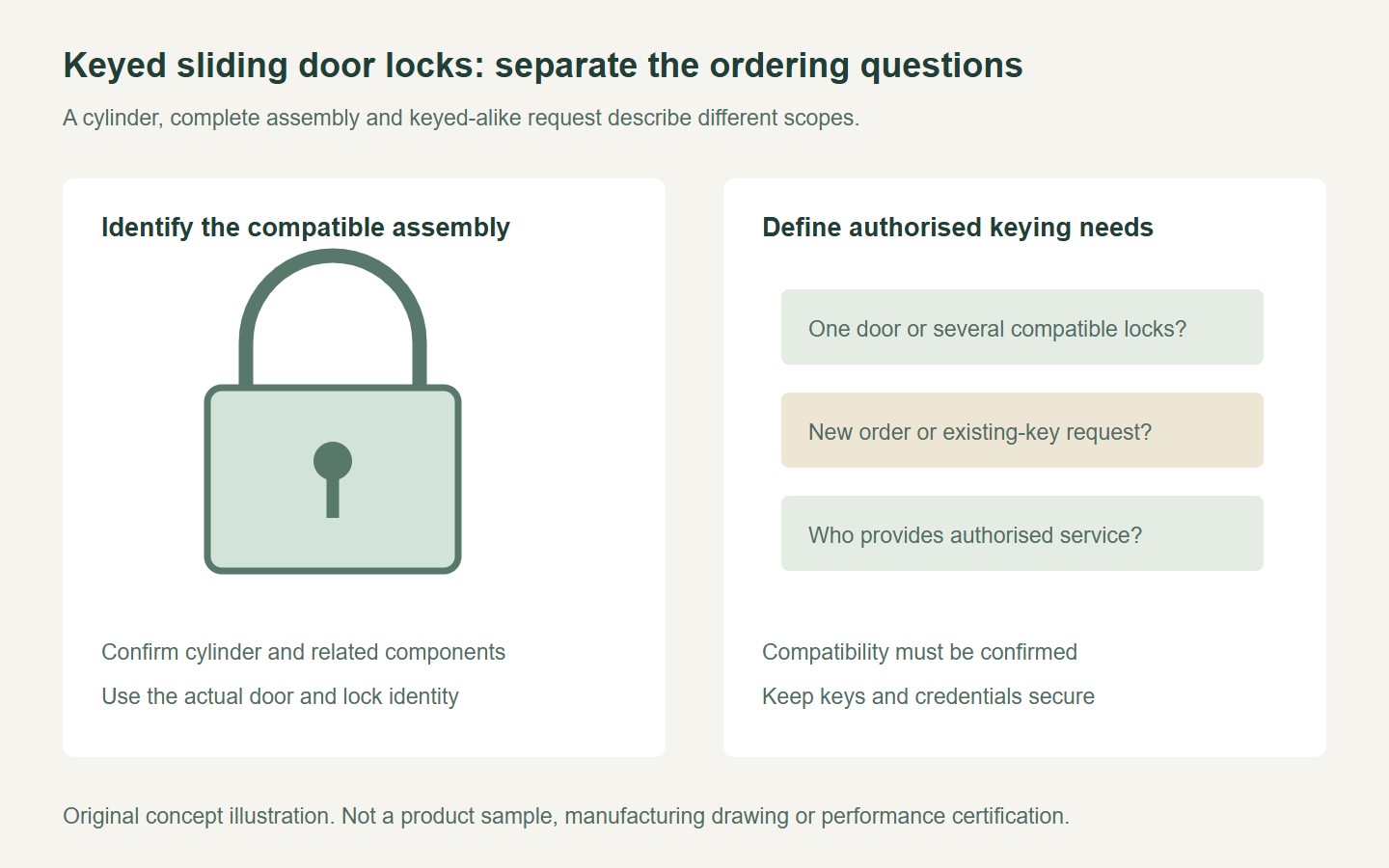
Clarify whether the request is a new access feature, a replacement cylinder or a complete lock replacement. Those scopes can involve different parts and preparation.
| Layer | Question to answer |
|---|---|
| Main mechanism | What engages the compatible receiver? |
| Exterior key access | How is authorised outside operation provided? |
| Auxiliary component | What additional, documented function does it serve? |
| Keyless control | How does the user request access? |
Keep these roles separate in the enquiry so the supplier can identify the correct parts.
Review auxiliary locks as system-specific additions
Andersen lists auxiliary foot-lock components for specified gliding-door products. Their auxiliary role and compatibility should be checked within the intended assembly.
Do not assume that an added component replaces the main lock or satisfies a separate security, child-protection or building requirement. Ask what the supplier actually documents for the product and use.
Review the normal operating sequence from both sides and the required passage or release. A supplementary device should not be added without understanding how it affects the users and the opening.
Where a special safety or regulated function is required, obtain the appropriate product and project review. A catalogue category or reassuring appearance is not a substitute for evidence.
Treat keypad and smart features as access methods
A keypad describes an input method and can be used in different technologies. Lockey identifies the C150 as a mechanical combination product, illustrating that numbered buttons do not automatically mean electronic or internet-connected operation.
For an electronic or connected proposal, confirm the supported credentials, power requirements, software support and documented fallback. Do not infer individual guest accounts or remote control from the presence of a keypad.
Mechanical compatibility remains necessary regardless of the control method. A connected feature cannot make an unsuitable lock body or receiver fit a different door.
Ask the supplier to document the actual functions supplied and demonstrate their normal authorised use. Keep access credentials secure and separate from ordinary project drawings.
Compare the complete arrangement before selecting a type
Write down the door identity, intended users, access from each side and any essential building function. Ask the provider to show how the main lock and proposed accessories meet that brief together.
For a retrofit, confirm supported preparation and compatible components before authorising physical changes. If the existing door operates poorly, have that concern assessed rather than assuming a different lock type will correct it.
- Identify the main mechanism and receiver.
- Define exterior and interior access needs.
- Assess compatible auxiliary functions.
- Confirm the actual keyless technology if proposed.
- Retain parts, operation and service records.
For a Forge door, provide the order reference and required locking function for review. The sliding door catalogue does not establish universal accessory compatibility. The useful comparison is the complete documented access arrangement for the actual opening.
Questions buyers ask
Is an exterior key cylinder the whole sliding-door lock?
Not necessarily. It can be one access component within a larger locking assembly. Identify the main mechanism, handles and receiver, then ask the supplier whether the required scope is a cylinder, accessory or complete lock replacement.
Does an auxiliary foot lock replace the main lock?
Do not assume it does. It has a documented supplementary role in particular systems. Confirm its compatibility and effect on normal operation, passage and release, and use evidence appropriate to any additional safety or security requirement.
Are keypad and smart locks always the same type?
No. Keypad access can be mechanical, electronic or connected, depending on the product. Confirm the exact technology and supported functions, then check mechanical compatibility with the complete door rather than choosing from the input method alone.
Prepared for Forge Windows and Doors (FoShan) Co., Ltd. Sources checked . Catalogue photographs and planning illustrations do not establish the performance of a supplied product.


