
Wooden sliding doors should be specified by their actual construction, finished weight and intended service conditions. A timber appearance can describe different products, including solid-wood components, engineered constructions or a veneer over another core. A wood-effect finish on another material is a separate description.
Start by asking how the leaf is made and how it should be stored, finished and maintained. Those requirements should be coordinated with the operating hardware before the order is approved.
Selection priority: confirm construction and care as well as appearance. Do not assume that every wooden leaf has the same movement, finishing or hardware requirements.
Describe the construction behind the surface
Ask for the leaf's material and build-up, including the core where relevant. A photograph of grain or a stained finish cannot establish how the whole door is constructed.
Identify the finished thickness, dimensions and complete weight. Decorative panels, glazing and hardware can change the final specification compared with an unfinished blank.
| Description | Question for the supplier |
|---|---|
| Solid-wood components | Which construction and species are used? |
| Engineered or veneered leaf | What is the core and how are faces and edges formed? |
| Wood-effect surface | What is the underlying material and finish process? |
| Glazed timber leaf | How are the glass, frame and hardware coordinated? |
Keep the agreed terminology consistent in the quotation and drawing. A visual substitute should not silently change the construction being supplied.
Consider moisture conditions for wooden sliding doors
Wood interacts with moisture in its environment, so storage and service conditions deserve attention. Ask the supplier which conditions and preparation steps apply to the selected leaf.
The US Forest Service Wood Handbook explains moisture relations and dimensional changes in wood. That principle does not provide a universal allowance or acclimatisation period for every completed door. The actual construction and manufacturer guidance still matter.
Tell the supplier whether the door is intended for an ordinary dry interior or a location with different exposure. Do not assume that an interior timber product is appropriate for an exterior or persistently damp setting.
If the room or building is still undergoing wet work, coordinate delivery and storage with the supplier's requirements. A finished-looking door should not be treated as indifferent to the construction environment.
Match the finished leaf to the operating system
Confirm the hardware conditions for the actual thickness, weight and fixing areas. A panel that looks similar to a catalogue example should not inherit that example's rating or installation detail.
The Johnson Hardware wall-mount range identifies system-specific leaf and fitting conditions. Use the exact hardware documentation when planning a surface slider, and the relevant frame information for a pocket or bypass arrangement.
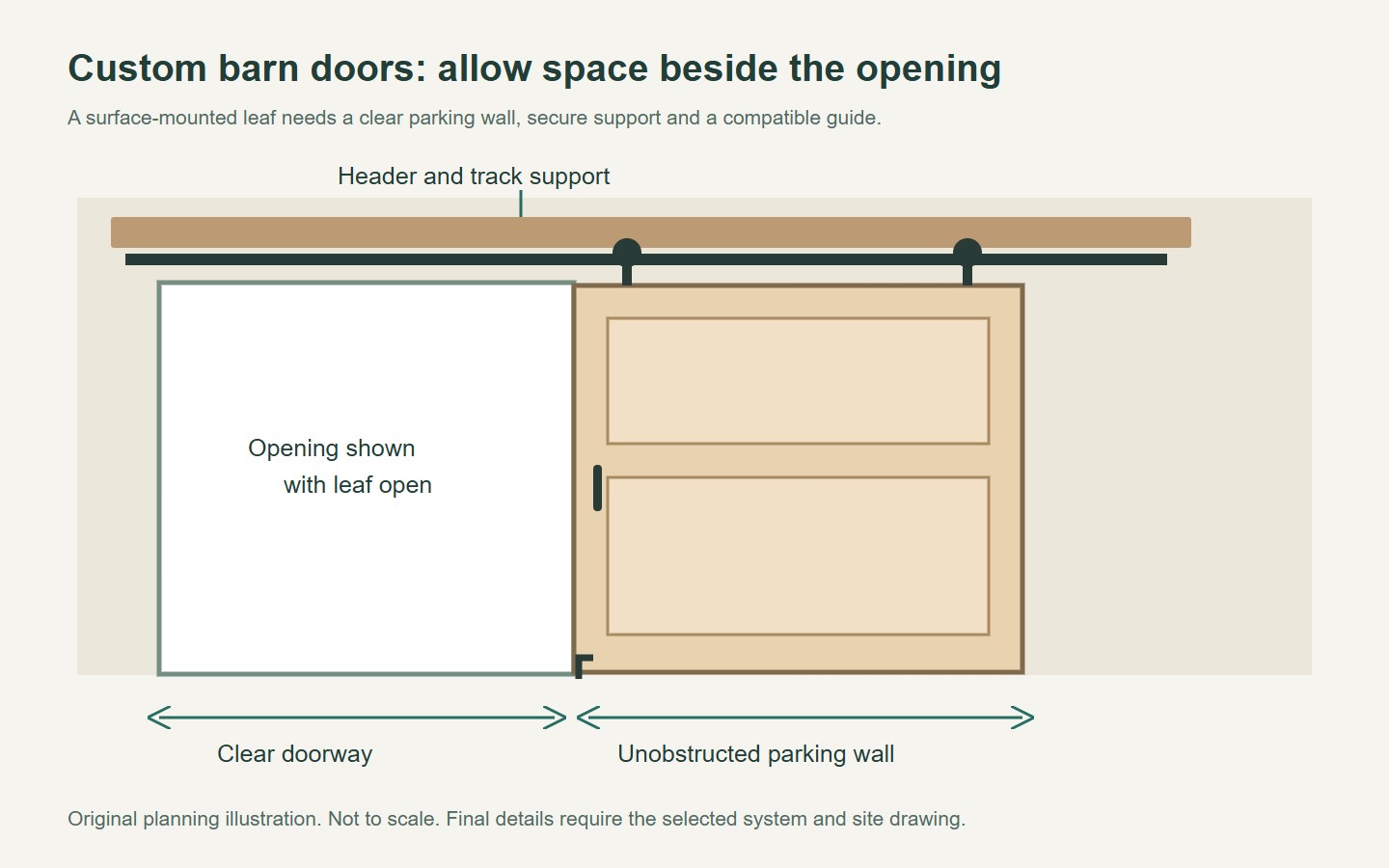
Keep the panel path and parked position clear of trim, fittings and furniture. A change in moulding depth or handle projection can affect the required clearance.
Approve the finishing and care requirements
Record the proposed finish and which surfaces are included. Faces, edges and hardware preparation should be coordinated with the manufacturer's guidance rather than finished independently without a shared specification.
Simpson Door provides product-specific care and finishing recommendations. This illustrates why advice for one manufacturer's door should not become a universal coating or storage rule for another.
Review the physical sample under the room's lighting and confirm the intended variation or appearance with the supplier. Do not promise identical grain or colour from a generic image.
Keep cleaning and repair information with the order. Avoid altering the surface or trimming a completed leaf without checking the effect on its construction, hardware and relevant written terms.
Keep delivery and installation traceable
Label the opening and leaf on the approved documents. Agree who confirms final measurements, checks the supporting construction and installs the hardware. Retain the relevant storage and handling instructions before the product arrives.
- Identify the actual construction and intended use.
- Confirm finished dimensions, thickness and weight.
- Coordinate moisture, delivery and storage conditions.
- Approve the hardware and finishing requirements.
- Retain the care information and service contacts.
For a related glazed alternative, review Forge sliding door configurations and the interior PT Door example. A wood-tone catalogue appearance does not establish a solid-timber supply. Ask Forge to confirm the actual material and proposed scope before ordering.
Wooden sliding doors are best chosen with a complete construction and care record. That lets the material's appearance support a practical assembly rather than stand in for its specification.
Questions buyers ask
Does a wood-grain finish mean the door is solid timber?
No. Confirm the actual construction, core and surface material. A veneer, engineered construction or wood-effect finish can create a similar appearance.
How long should every wooden door acclimatise?
There is no universal period provided here. Follow the selected manufacturer’s requirements for the actual construction, delivery environment and intended use.
Can any wooden leaf be fitted to an exposed sliding rail?
Only if its dimensions, finished weight, thickness and fixing areas are compatible with the selected hardware and support. Obtain confirmation for the complete arrangement.
Prepared for Forge Windows and Doors (FoShan) Co., Ltd. Sources checked . Catalogue photographs and planning illustrations do not establish the performance of a supplied product.


