
For 2 panel sliding closet doors, match the complete finished leaves to the exact hardware system. Panel count alone does not establish track compatibility, weight capacity or the required guides and stops. Confirm the construction and operating parts together before ordering separate components.
This guide focuses on the assembly specification for a two-panel closet. It is useful when comparing a complete kit with separately sourced leaves and hardware, or when an added mirror or finish changes the original panel description.
Assembly check: obtain the finished leaf dimensions and weight, identify the hardware version and confirm all required supporting and operating components.
Define what each finished leaf includes
Record the panel construction, face materials, frame, thickness and any added insert. A plain leaf and one carrying a mirror or decorative facing can have different requirements even when their external dimensions match.
Ask the supplier for the finished weight used to select the hardware. Include the complete supported leaf rather than relying on the weight of its core or a generic material estimate.
Confirm the appropriate fixing areas and preparation. A panel that looks solid from the front may have a construction that needs a particular attachment method. The leaf and hardware suppliers should agree compatibility before fabrication.
Keep those details attached to each panel reference in the order. If a finish or insert changes later, have the responsible supplier confirm that the hardware selection remains appropriate for the revised assembly.
Identify the exact hardware version
The Johnson Hardware 138F range distinguishes different hanger and operating configurations. A family name therefore does not establish the same capacity or parts for every available kit.
As one specific example, Johnson lists a two-door 138F hardware set with its own leaf and hanger parameters. Use the current documentation for the actual set rather than applying that example to an unrelated closet system.
| Specification item | Confirmation required |
|---|---|
| Finished leaf | Dimensions, construction and supported weight |
| Hardware identity | Exact part or system version |
| Support and guidance | Approved top, bottom and side arrangement |
| Operating options | Compatible handles, stops and selected closing features |
Ask whether the published limit is per leaf and what configuration it assumes. Do not add together unrelated component ratings to create a capacity for the whole installation.
Confirm the complete kit, including small components
Compare the parts list with the drawing. Track, hangers or rollers, guides, stops, handles and any selected closing mechanism should be accounted for in the appropriate system.
A small omitted component can affect the permitted movement. Do not treat a guide or stop as an optional accessory simply because it is less visible than the main track.
The Contractors Wardrobe Colonial product identifies its frame, insert, track and guide arrangement. It illustrates a complete specified closet-door construction that differs from separately choosing a top-hung kit. Do not mix those categories without an approved design.
Ask who supplies fasteners and any supporting preparation required at the opening. Those details should follow the selected product and site conditions, rather than a generic list copied from another installation.
Check the pair against the closet contents
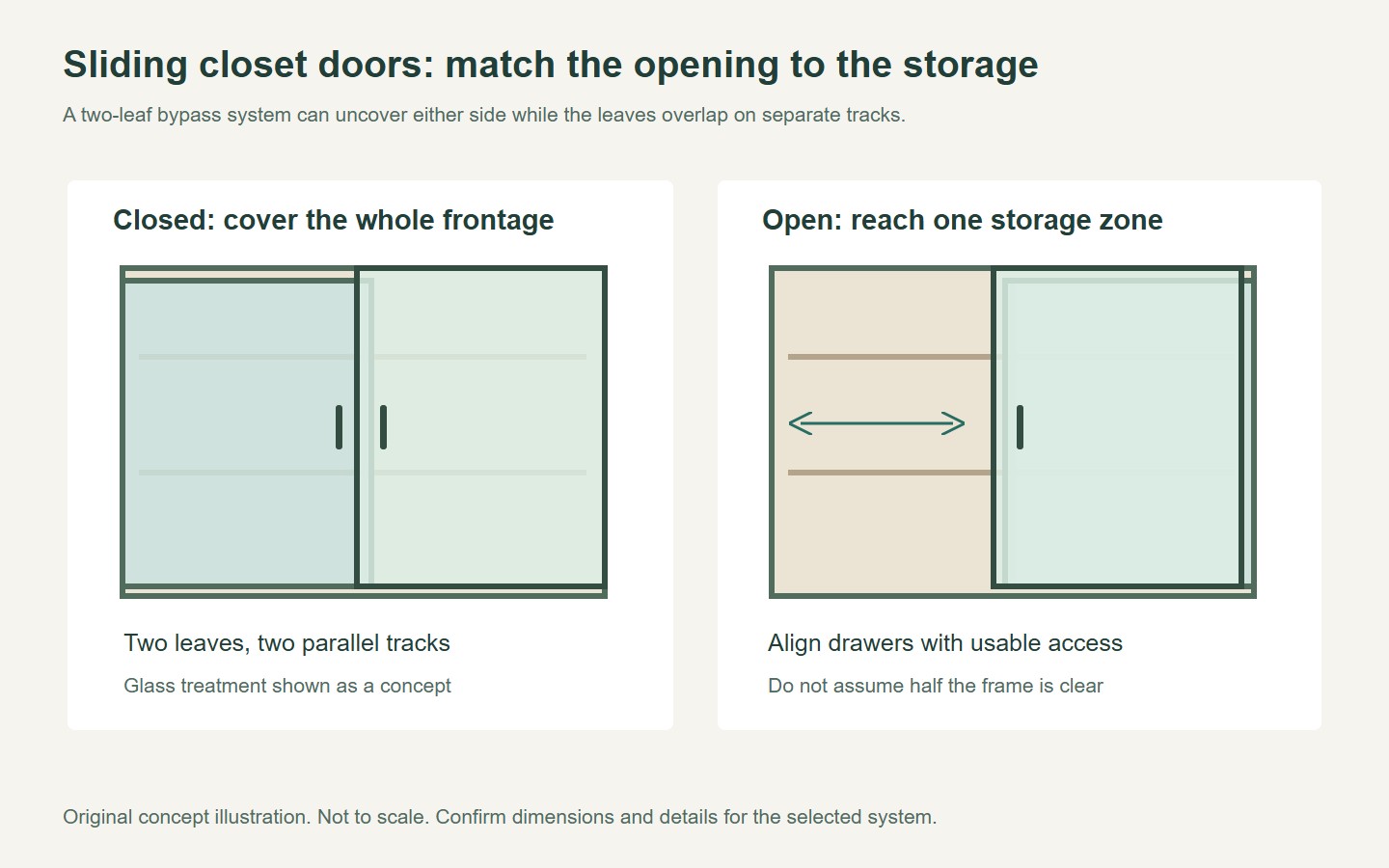
Show the actual leaves in both open positions and confirm that drawers, baskets and shelves remain usable. Hardware compatibility does not by itself guarantee a convenient storage layout.
Check handle projection and access at the overlap. A change in leaf thickness or added decorative panel can affect movement, so the review should use the final construction.
Ask how the selected stopping and closing positions are established in the approved design. Extending travel beyond that arrangement to reach a blocked drawer should not be assumed acceptable.
Keep a serviceable assembly record
Retain the final leaf specification, hardware part references and installation instructions together. This helps a future service provider identify a worn component without guessing from appearance.
At handover, ask for a demonstration of normal operation and permitted routine care. Confirm access for cleaning and service, including the procedure for any task that requires a qualified person to handle the panels.
Record substitutions and approved changes so that the installed assembly can be distinguished from the first quotation. Do not discard the final parts list because the door appears to work on the first day.
For related interior options, review Forge interior door examples and ask the supplier to confirm the complete closet-door construction. A two-panel assembly is ready to order when the leaves, hardware and opening are documented as compatible parts of the same system.
Questions buyers ask
Can I choose hardware from the door width alone?
No. Finished leaf weight, thickness, construction, fixing areas and the intended movement also matter. Obtain the actual hardware version and its requirements, then have the supplier confirm compatibility with the complete final leaf and supporting opening.
Does adding a mirror affect a closet door specification?
It can change the finished leaf construction and weight, so the change should be reviewed before ordering or alteration. Ask the responsible suppliers to confirm the mirror, panel support and hardware together rather than assuming the original kit remains suitable.
Are all two-panel closet doors top-hung?
No. Different systems use different supporting and guiding arrangements. Identify the exact assembly and follow its documentation. A top-hung hardware kit and a complete bottom-rolled closet system should not be treated as interchangeable component packages.
Prepared for Forge Windows and Doors (FoShan) Co., Ltd. Sources checked . Catalogue photographs and planning illustrations do not establish the performance of a supplied product.


