
Barn sliding doors are sold in different scopes: a leaf, a hardware package, a combined set or a complete installed solution. Confirm what is included before comparing prices. A complete hardware kit does not necessarily mean the quotation covers the door, building preparation and installation.
For a buyer assembling an order from more than one supplier, compatibility and responsibility are as important as the item list. The final leaf and hardware need to be reviewed together, even when they arrive in separate packages.
Before purchase: build a simple component schedule, identify any exclusions and confirm who supplies and installs each part. Compare equivalent scopes rather than headline prices.
Identify the type of offer
Read the product title and the detailed contents together. Terms such as set, kit and complete can refer to different boundaries. Ask the seller to confirm the exact items rather than assuming a familiar word covers everything needed.
RealCraft has hardware-specific barn-door listings, while National Hardware describes components for hanging a door within a named kit. These examples show why the actual listing contents matter more than the broad product category.
| Offer type | What to confirm |
|---|---|
| Door leaf | Construction, finish and any preparation; hardware scope stated separately |
| Hardware kit | Track, hangers, guides, stops and other listed components |
| Combined leaf and hardware | Compatibility and remaining installation items |
| Installed solution | Preparation, fitting, finishing and handover responsibilities |
A supplier's current written contents list should govern the comparison. Do not assume that every package with a similar photograph includes the same accessories.
Check barn sliding doors at component level
List the finished leaf, operating hardware, guides, stops, handles and any locking or closing option. Identify the relevant model references and whether any component is optional.
Ask which mounting items are included and whether they suit the actual supporting construction. Hardware in a box is not proof that the opening has suitable support or that the supplied fasteners are appropriate for every substrate.
Record any additional trim, cover, backing or finish work that the project requires. These items can be part of the installed scope even if they are not part of the product package.
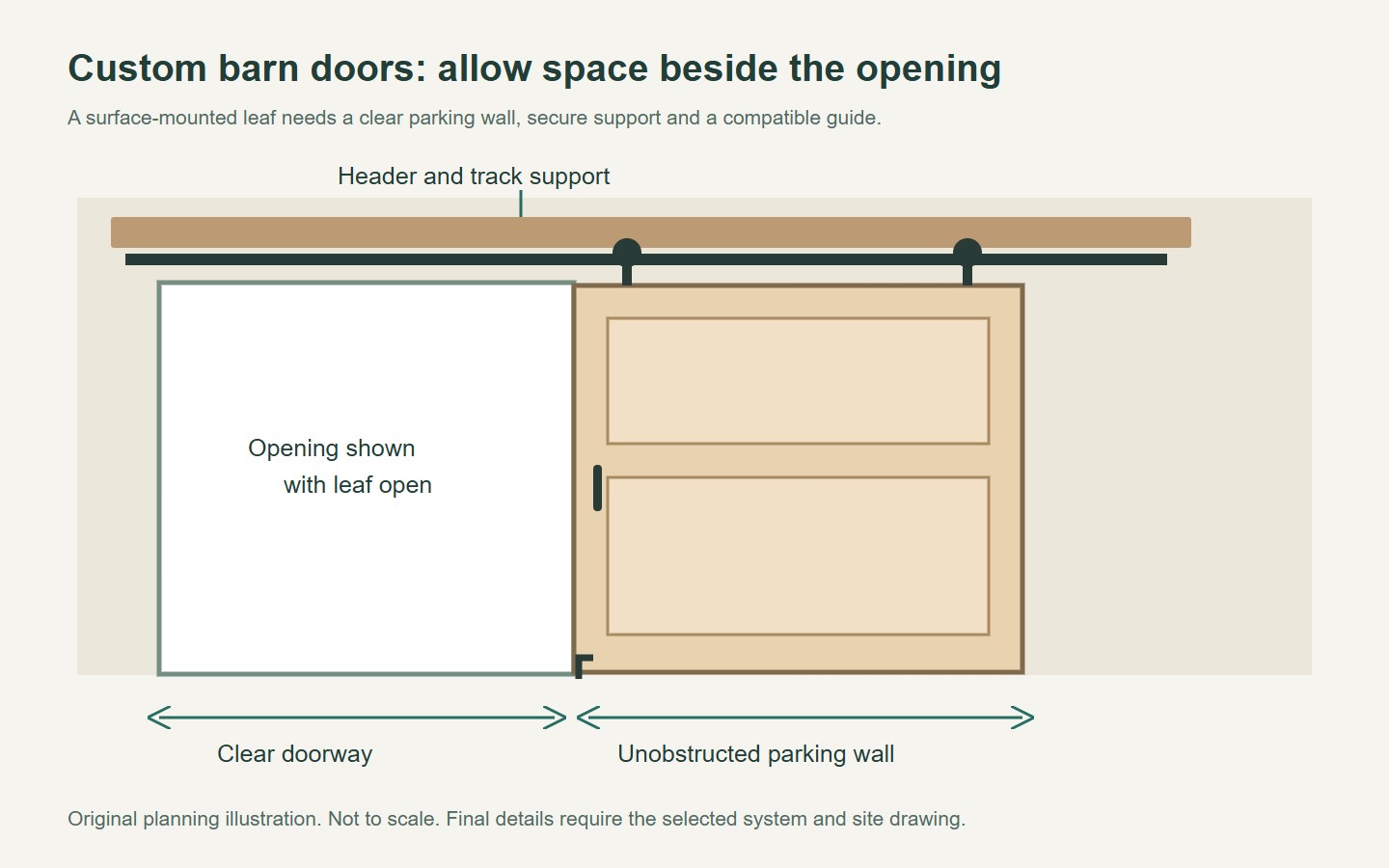
Keep leaf and hardware compatibility together
Confirm the complete finished leaf weight, thickness and construction before selecting hardware. Added glazing, applied panels or a change in fittings may alter the requirements.
Ask the responsible supplier to confirm compatibility in writing when the leaf and hardware are sourced separately. A similar width or finish does not establish that parts work together.
Review the full travel with handles and accessories included. A kit can be suitable for a leaf while the intended room arrangement still has a conflict with a wall, switch or piece of furniture.
For glass or a specialised application, obtain the relevant system and project review. A kit intended for an ordinary timber interior leaf should not be assumed suitable for glass, an exterior opening or a required fire function.
Compare the complete installed scope
The product price is only one part of an installation where preparation and finishing are needed. Identify removal of the old door, support work, making good, floor coordination and delivery responsibilities where applicable.
The Federal Trade Commission recommends comparing written estimates that describe the work and materials. Use that approach to make the exclusions visible before judging which proposal costs less.
For example, if one offer includes the leaf and rail while another includes installation and making good, obtain the missing scope before comparing totals. No market price or standard installation allowance is assumed here.
Keep the same drawing and intended configuration in every enquiry. An inexpensive alternative may change the leaf material or operating features, so record the difference explicitly.
Confirm the order and handover responsibilities
Before accepting the proposal, identify who approves final dimensions, who checks the support and who resolves any compatibility question. Keep those responsibilities linked to the component schedule.
- Classify the offer as leaf, hardware, combined set or installed work.
- List included components and explicit exclusions.
- Confirm the finished leaf and compatible hardware.
- Review the room and building preparation.
- Record installation, care and service responsibilities.
For a related glazed option, review Forge sliding door configurations and the interior PT Door example. The catalogue does not establish compatibility with a separately purchased barn kit. Ask Forge to confirm the exact material and supply scope before ordering.
Barn sliding doors are easier to compare when the scope is visible at component level. A complete item list and clear responsibilities help turn a product purchase into a coordinated installation.
Questions buyers ask
Does a complete barn-door kit include the leaf?
Do not assume that it does. Complete may refer only to the listed hardware. Ask for the current written contents and identify the leaf, accessories and installation scope separately.
Can I mix a door and hardware from different suppliers?
Only after compatibility and responsibilities are confirmed. Check the finished leaf construction, weight, thickness and preparation against the exact hardware requirements.
Why can installed quotations differ from online kit prices?
They may include preparation, support work, fitting, making good, delivery or other services. Compare the same defined scope before judging the total cost.
Prepared for Forge Windows and Doors (FoShan) Co., Ltd. Sources checked . Catalogue photographs and planning illustrations do not establish the performance of a supplied product.


