
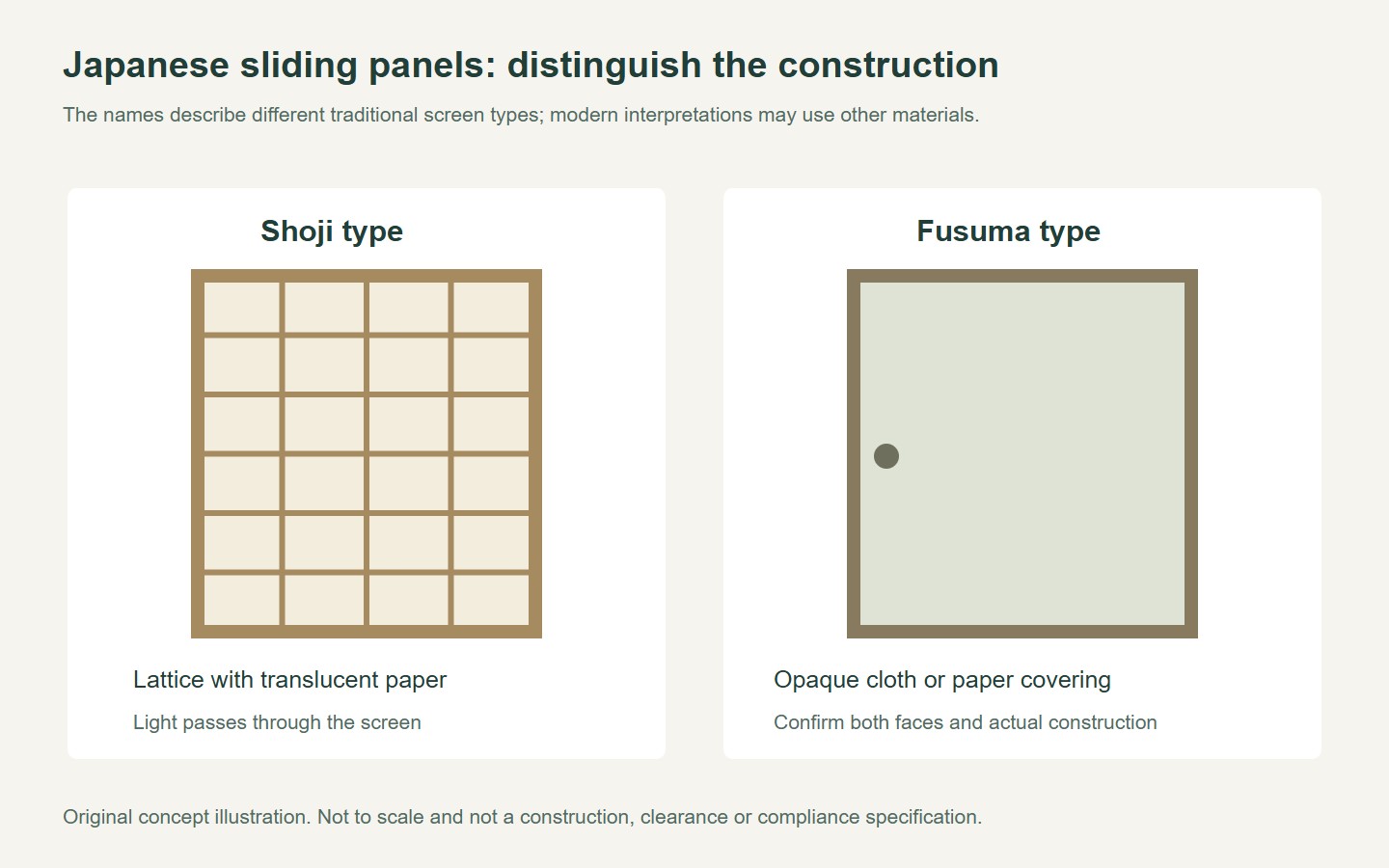
Japanese sliding panels include different traditional screen types, so the name should be clarified before selecting a design. Shoji are associated with translucent paper on a wooden lattice, while fusuma form a more opaque room boundary. A modern product inspired by either appearance may use a different construction.
The useful starting point is the role of the panel in the room: admitting softened light, screening a view or dividing spaces. Identify that role and the actual materials rather than treating every Japanese-style sliding panel as the same product.
Before ordering: distinguish the traditional reference from the proposed construction, then review the room layout, sample and care requirements.
Distinguish shoji from fusuma
The Japan Forum describes shoji and fusuma within the Japanese-style room, or washitsu. Its explanation distinguishes translucent paper applied to a shoji frame from the cloth or paper covering on both sides of fusuma.
Web Japan describes shoji as paper-covered wooden lattice screens that admit soft light. These definitions help explain why the two screen types should not be used as interchangeable names in a product order.
| Traditional reference | Main distinction | Question for a modern product |
|---|---|---|
| Shoji | Lattice and translucent paper associated with softened light | What are the actual frame and infill materials? |
| Fusuma | A more opaque covered panel used to divide space | How are both faces and the internal construction made? |
| Japanese-style interpretation | A visual reference that may use another construction | Which traditional features are retained and which are changed? |
This is a simplified distinction for design discussion, not a claim that every historic example or modern maker uses an identical detail.
Choose Japanese sliding panels around the room boundary
Decide whether the panel should transmit light or primarily separate the view between rooms. That decision affects the infill and the relationship between the spaces, not just the decorative pattern.
Review the room with the panels open and closed. Consider where they overlap or park, which routes remain available and how the adjoining space appears from occupied positions.
If a particular acoustic, fire or other building function is required, identify it separately. A traditional visual reference does not establish a modern assembly's performance or suitability for a regulated location.
Review the material and sample honestly
Ask the maker to identify the frame, infill, surface covering and method of assembly. A product described as Japanese style may use glass, a composite panel or other modern materials. Those choices should be stated clearly.
Shoji Bau provides examples of wooden frames with translucent shoji paper. Such maker information can illustrate a defined construction, but it should not be attributed to another supplier without confirmation.
Test the sample under relevant daylight and evening lighting. A translucent surface can show silhouettes or contrast, so determine whether the result suits the intended use rather than assuming complete privacy.
For an opaque or decorated panel, inspect both faces and the edges. Sliding panels are often visible from adjoining rooms and in their parked positions, making those details part of the design.
Coordinate the actual operating system
Identify how the proposed panels move and are guided. A modern hardware system may operate differently from a traditional screen arrangement. The product name alone does not specify the track, support or leaf limits.
Show the fully open position and the usable passage on the drawing. Keep furniture and controls outside the required movement and parking zones. Do not assume a light-looking panel has no support or guidance requirements.
Confirm handle or pull positions in the open and closed states. A visually discreet detail still needs to be usable by the people in the room.
Where an existing building or interior is being altered, have the relevant construction and requirements reviewed. A movable-looking panel should not be confused with permission to remove an unknown wall or required boundary.
Choose a care method you can maintain
Ask how the actual infill and frame should be cleaned, repaired or replaced. Paper, cloth coverings, glass and painted surfaces can need different care. Keep the maker's instructions with the order rather than using a generic method for all Japanese-style panels.
- Name the traditional reference accurately.
- State the intended light and room-boundary effect.
- Confirm the actual construction and sample.
- Review panel movement, parking and handles.
- Obtain the relevant care and service information.
For a modern glazed alternative, compare Forge sliding door options and the interior PT Door example. These do not establish a traditional shoji or fusuma supply. Ask Forge to confirm the proposed materials and scope before ordering a related configuration.
Japanese sliding panels are easier to select when their names, materials and room functions are kept distinct. An accurate description respects the design reference while helping the buyer evaluate the product actually offered.
Questions buyers ask
Are shoji and fusuma the same kind of panel?
They are distinct traditional references. Shoji are associated with translucent paper and lattice, while fusuma use covered, more opaque panels. Confirm the actual construction of any modern product offered under those names.
Does Japanese style mean the product is made in Japan?
No. A style description does not establish origin, craftsmanship or material provenance. Ask the supplier for accurate construction and origin information if those factors matter to the purchase.
Can a modern glazed panel replace a traditional screen directly?
Do not assume interchangeability. Weight, hardware, support, dimensions and room requirements may differ. Have the proposed replacement reviewed as a complete system.
Prepared for Forge Windows and Doors (FoShan) Co., Ltd. Sources checked . Catalogue photographs and planning illustrations do not establish the performance of a supplied product.


