
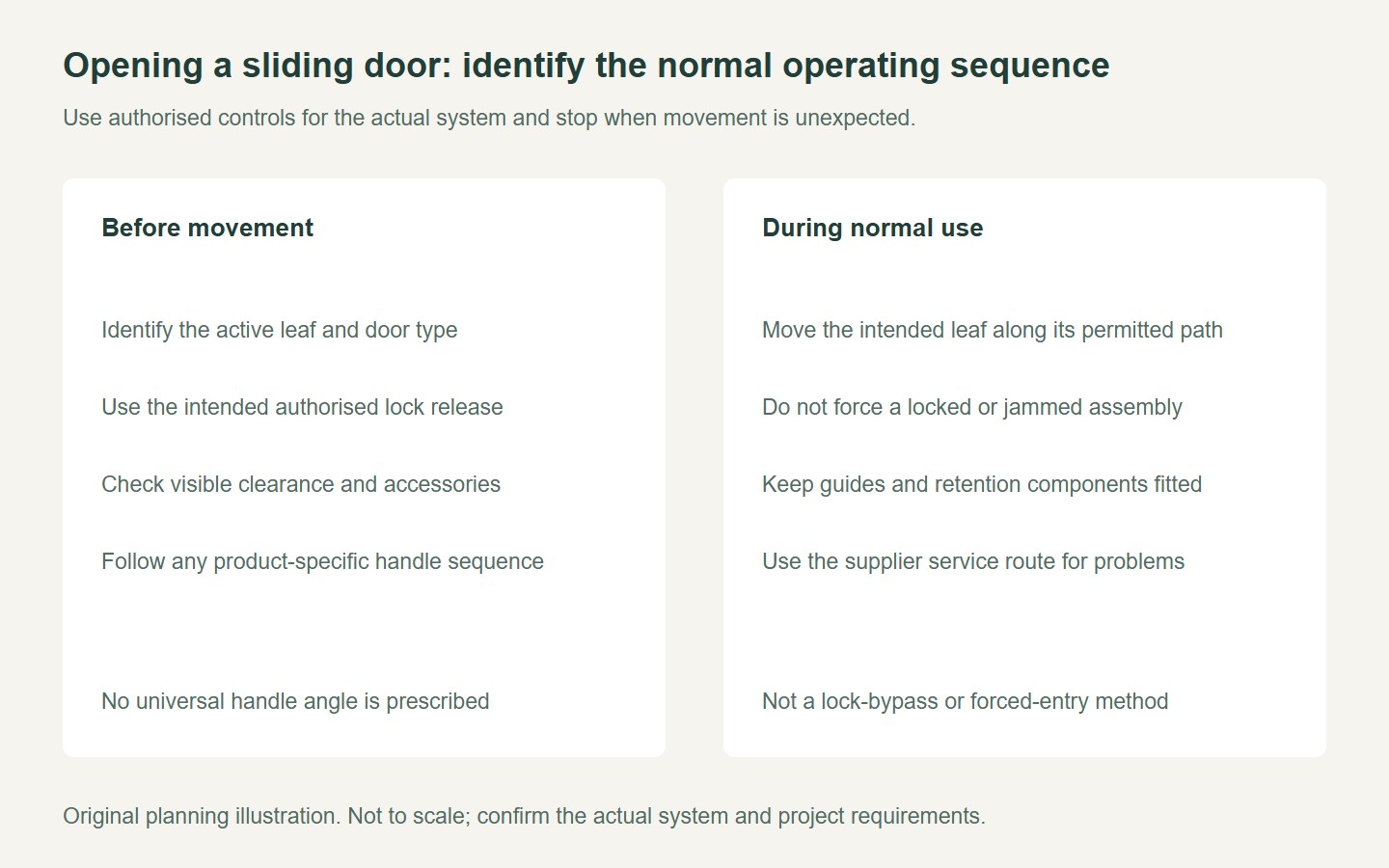
To open a sliding door normally, identify the active leaf, release its intended lock using the authorised control and follow the manufacturer's operating sequence. Move only the intended panel along its permitted path. Stop if the assembly remains restrained or movement is unexpectedly difficult rather than forcing it.
The exact sequence depends on the system. A conventional gliding patio door, an interior manual slider, a lift-and-slide door and an automatic entrance can use different handles and controls.
First check: confirm what moves and how the actual product is operated before applying pressure to the panel.
How to open sliding door systems starts with identification
Look at the whole opening and identify the intended handle and active leaf. A glazed section may be fixed even when it resembles the adjacent moving panel.
Use accessible product labels or the original documents where available. Andersen provides a worksheet for identifying gliding patio-door products, which can help distinguish similar-looking assemblies.
Confirm the operating direction through the actual system information rather than assuming left and right from a single view. Screens and coverings may have their own separate movement.
Do not remove a guide, stop or retention part in an attempt to discover which panel moves. Those components can be part of the normal complete arrangement.
Use the intended authorised lock and handle controls
Release the normal lock through the product's intended control, using the appropriate key or authorised interior operation where required. Do not treat a locked door as a jam to be overcome by force.
Confirm that any approved supplementary device has been released through its normal instructions. If its function is unclear, identify it through the owner or supplier rather than dismantling it.
For a product that requires a particular handle sequence before movement, follow that actual instruction. Do not copy a rotation angle or handle action from a different door.
| System type | What to identify before opening |
|---|---|
| Conventional manual slider | Active leaf, authorised lock control and permitted travel |
| Lift-and-slide | Product-specific handle and panel-release sequence |
| Interior sliding system | Actual latch, guide and operating arrangement |
| Powered entrance | Approved activation and owner instructions |
Distinguish ordinary sliding from lift-and-slide movement
An interior manual system such as dormakaba MUTO has its own configured operation and options. Use the actual product information rather than assuming all manual sliding doors are identical.
The Marvin Ultimate Lift and Slide technical information describes a handle-related lifting and lowering function. This is a named system characteristic, not an instruction to physically lift an ordinary patio panel by hand.
Once the selected door is in its intended operating state, move the active leaf along the permitted path using normal operation. Do not force it beyond its stops or through an unexpected obstruction.
For powered doors, use the approved activation method and appropriate owner guidance. Do not push against a powered mechanism or bypass protective sensors to make it move.
Stop and assess unexpected resistance
If the panel does not move as expected, stop and confirm the product and normal controls. Check for an obvious obstruction in the visible route without putting hands into unsafe mechanisms or dismantling the assembly.
Andersen explains that difficult locking operation can involve alignment or affected hardware. An operating problem should be assessed through the actual product guidance rather than diagnosed from one symptom.
Do not pry at the panel, strike the glass or loosen supporting components as a shortcut. Large or glazed leaves need appropriate handling when service work is required.
If the door is locked and authorised access is unavailable, contact the owner, manager or a qualified authorised service provider. The correct next step is access assistance, not an improvised opening method.
Keep normal-use and care information with the door
At installation or handover, ask for a demonstration of the actual opening, closing and authorised locking sequence. Include screens, coverings and selected operating options.
Retain the model and hardware references so later questions can be answered for the installed system. A photograph of a similar door may not identify the same mechanism.
Follow routine care instructions and use the service route when movement changes. Keeping required parts installed and addressing faults appropriately helps preserve the intended operation.
- Identify the active leaf and actual system.
- Use the normal authorised lock and handle sequence.
- Move the intended panel along its permitted path.
- Stop when movement is unexpected.
- Retain operating instructions and obtain suitable service when needed.
For a supplied Forge assembly, send the model or order reference when asking how it operates. Describe the controls and symptoms clearly so the supplier can provide the appropriate product-specific information.
Questions buyers ask
Should I lift a patio door if it will not slide?
Do not physically lift or force an unidentified panel. Some lift-and-slide systems use a specific handle sequence, while ordinary sliders work differently. Identify the actual product and use its normal instructions or service route.
What if the normal lock is released but the door is still difficult to move?
Stop and check the actual operating instructions and visible clearance. Have unexpected resistance assessed by an appropriate service provider rather than prying, striking glass or loosening supporting hardware.
Can this guide open a locked door without authorised controls?
No. It describes normal authorised operation. If access is unavailable, contact the owner, manager or an authorised professional who can assess the actual door and access situation.
Prepared for Forge Windows and Doors (FoShan) Co., Ltd. Sources checked . Catalogue photographs and planning illustrations do not establish the performance of a supplied product.


