
A plexiglass sliding door should be specified as a complete acrylic-panel assembly, including the actual material, support, preparation and running hardware. Plexiglass is commonly used as a term for acrylic, while PLEXIGLAS is a branded acrylic product. Confirm the actual supplied material rather than treating every clear plastic sheet as the same product.
Acrylic sheet, polycarbonate and mineral glass are different materials. A similar clear appearance does not establish the same fabrication, cleaning or application requirements, and a sheet alone is not a complete door.
Specification approach: identify the acrylic grade and finished panel, then verify a suitable supported sliding arrangement for the intended use.
Identify the plexiglass sliding door material
The PLEXIGLAS GS/XT product information identifies acrylic as polymethyl methacrylate, or PMMA. Ask for the actual brand or product reference, grade, thickness and finish supplied for the project.
Do not confuse acrylic with polycarbonate merely because both can be transparent. If an alternative material is proposed, have the complete specification and suitability reviewed rather than treating it as a like-for-like name change.
State whether the enquiry concerns a fabricated acrylic leaf, a sheet infill within a frame or another defined construction. The supporting and operating arrangement should be identified separately from the sheet.
Keep colour and transparency choices distinct from technical requirements. A clear, translucent or opaque appearance does not establish a complete door's performance.
Coordinate the panel with its support and movement
Record the finished dimensions and the way the acrylic is supported within the proposed assembly. Ask the fabricator to account for the actual material behaviour, preparation and intended environment.
Confirm appropriate movement allowances and mounting details through the selected system. Do not use a generic glass or timber fixing detail without checking that it suits the actual acrylic panel.
| Specification field | What to confirm |
|---|---|
| Acrylic | Actual PMMA product, grade, thickness and finish |
| Panel construction | Dimensions, edges and supporting frame where used |
| Hardware | Compatible running, guiding and stopping components |
| Preparation | Permitted holes, mounting and allowances by design |
| Application | Relevant requirements for the intended location |
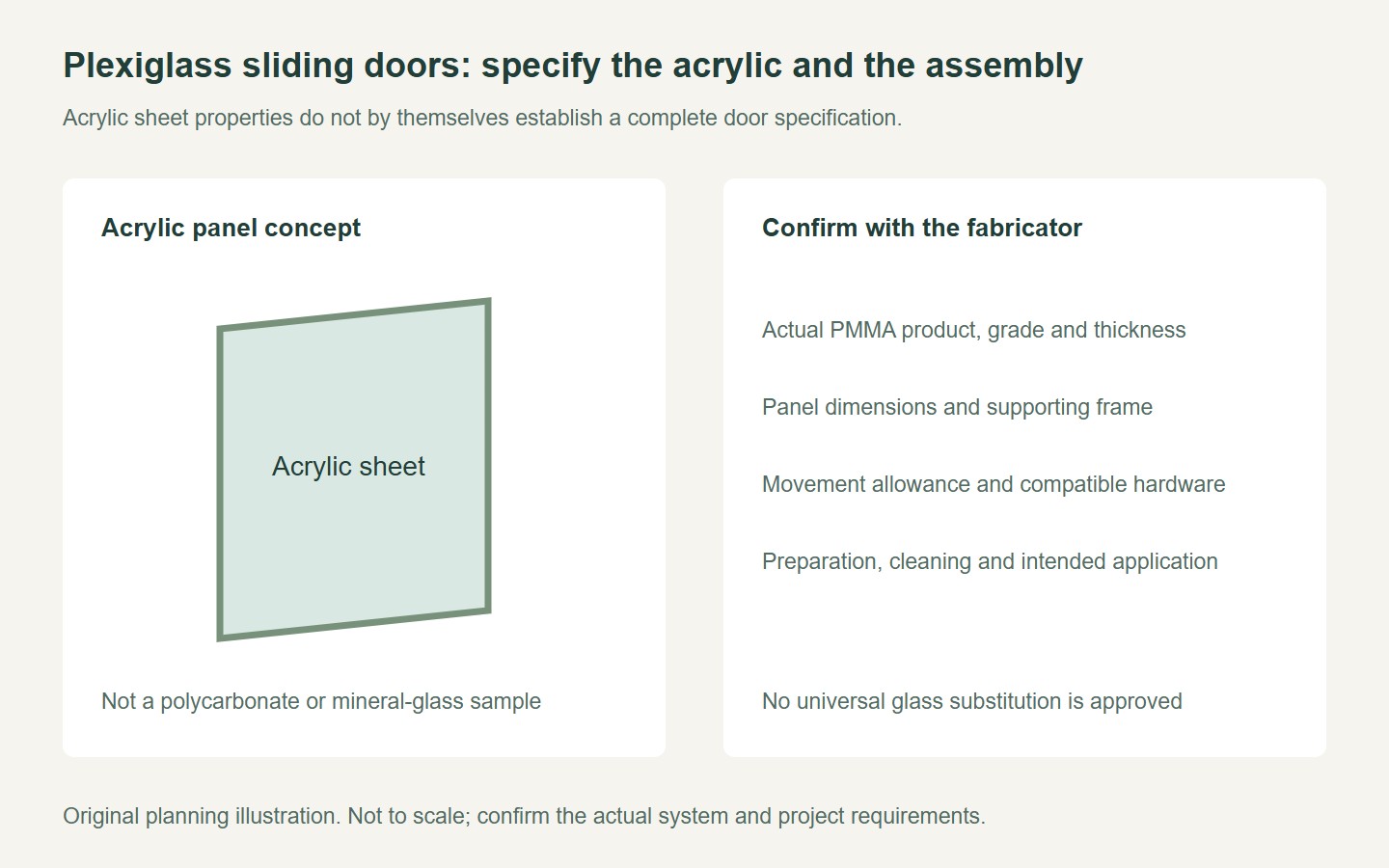
Use material-specific fabrication guidance
PLEXIGLAS provides processing guidance for drilling its acrylic products. The relevant lesson is to use the actual material and product requirements, not to treat the sheet as ordinary wood or an already approved door leaf.
Have fabrication and preparation completed through suitable expertise for the actual assembly. A general material-processing guide does not define every door-specific hole position, support condition or hardware fit.
Do not transfer acrylic processing methods to tempered mineral glass. Identify the material before any alteration and confirm the required preparation with the responsible supplier.
If an existing door is being modified with an acrylic infill, obtain confirmation of compatibility before removing or replacing its original panel. Similar dimensions do not establish equivalent function.
Confirm the intended use and relevant evidence
Describe whether the panel is for furniture, an internal divider or another specific location. Exterior, wet-area, protective and other specialised applications need appropriate complete-system assessment.
A material described as light, transparent or weather-resistant does not by itself prove that an improvised sliding door meets the project's required performance.
Keep any safety-glazing, fire, acoustic, security or other function in a separate specification field. Request relevant evidence for the actual assembled product where required rather than inferring it from the polymer name.
Review the normal movement and access with handles, trim and adjacent leaves in place. The complete arrangement must remain practical as well as visually suitable.
Follow compatible cleaning and retain product references
PLEXIGLAS publishes cleaning and maintenance guidance for its branded acrylic. Use the actual product's compatible care method rather than assuming ordinary glass cleaners or solvents are suitable.
Keep the sheet and hardware care requirements separate where their surfaces differ. Routine cleaning should not become an unapproved polishing, coating or alteration process.
If damage or changing operation occurs, have the actual material and assembly assessed. Do not replace a panel from an approximate visible measurement without confirming its complete construction and preparation.
- Identify the actual acrylic product.
- Specify the panel and supporting arrangement.
- Use appropriate material-specific fabrication.
- Confirm the application and complete-system evidence.
- Retain compatible care and replacement information.
When asking Forge about an acrylic or plexiglass requirement, describe the intended use and request confirmation of available suitable options. Do not assume a standard glass-door system permits an arbitrary plastic substitution.
Questions buyers ask
Is plexiglass the same as polycarbonate?
No. Plexiglass commonly refers to acrylic, or PMMA, while polycarbonate is a different polymer. Confirm the actual supplied material and product rather than using clear plastic as a complete specification.
Can acrylic replace glass in any sliding door?
Do not assume compatibility. The supporting frame, hardware, preparation and required function must be assessed for the actual substitution. A sheet-material description does not establish a complete equivalent door.
Can I clean acrylic with any glass cleaner?
No. Use the actual acrylic product's compatible cleaning guidance. Some cleaners or treatments can be unsuitable, so identify the material and care requirements before applying a product intended for another surface.
Prepared for Forge Windows and Doors (FoShan) Co., Ltd. Sources checked . Catalogue photographs and planning illustrations do not establish the performance of a supplied product.


