
To secure a sliding glass door from the inside, close the operating panel fully and engage its intended primary lock according to the manufacturer's instructions. Confirm normal operation and use only compatible approved supplementary options. Preserve any required exit function rather than improvising a barrier that prevents the opening from being used as needed.
The useful approach is to maintain the complete door and its intended locking arrangement. A damaged frame or a lock that does not engage correctly needs assessment, not an unrelated accessory added to hide the problem.
Inside check: confirm the actual system, close and lock it normally, review compatible options and retain a practical authorised-use routine.
How to secure a sliding glass door from the inside starts with the primary lock
Identify the actual door and its normal locking control. Follow the product's ordinary closing and locking sequence rather than assuming every patio slider uses the same handle or latch action.
Check that the operating leaf reaches its intended closed position and that the lock engages normally. Do not force the mechanism or treat unusual resistance as evidence that it is more secure.
Andersen provides product-specific gliding-door locking and service information. If the assembly is difficult to operate, use the appropriate instructions or a qualified service provider to assess the actual cause.
Keep the product reference and observed symptoms available for that assessment. A generic description such as the inside lock is stuck may not identify the correct component.
Check the complete door condition and required components
Review the frame, glazing and accessible operating parts for damage or changed condition. Have loose, damaged or unidentified components assessed through the appropriate service route.
Secured by Design provides defensive guidance for sliding patio doors, including attention to suitable locking and retention features. Use that to review the complete assembly, not to improvise a modification to an unknown frame.
Retain required guides, stops and panel-retention parts. Their presence and condition belong to the door's normal intended operation.
| Inside review item | What to confirm |
|---|---|
| Primary lock | Normal engagement with the leaf fully closed |
| Frame and panel | Identified system without unresolved damage |
| Required hardware | Guides, stops and retention components remain as specified |
| Added option | Actual manufacturer compatibility and installation |
| Exit and access | Required authorised use remains available |
Use supplementary hardware only where it fits the actual system
Ask the manufacturer or qualified installer which approved supplementary options are appropriate for the identified door. Confirm the function and required installation before purchasing.
The Andersen Auxiliary Foot Lock guide identifies an accessory for specified gliding-door series. It is a product-specific example, not a universal fitting instruction for every sliding glass door.
Do not drill an unidentified frame, sill or glass panel from a generic online template. Installation may involve more than attaching a visible accessory, so use the actual instructions and suitable expertise.
Keep any selected device within the complete design and required access functions. A supplementary lock should not be treated as a substitute for a primary mechanism that is damaged or cannot engage.
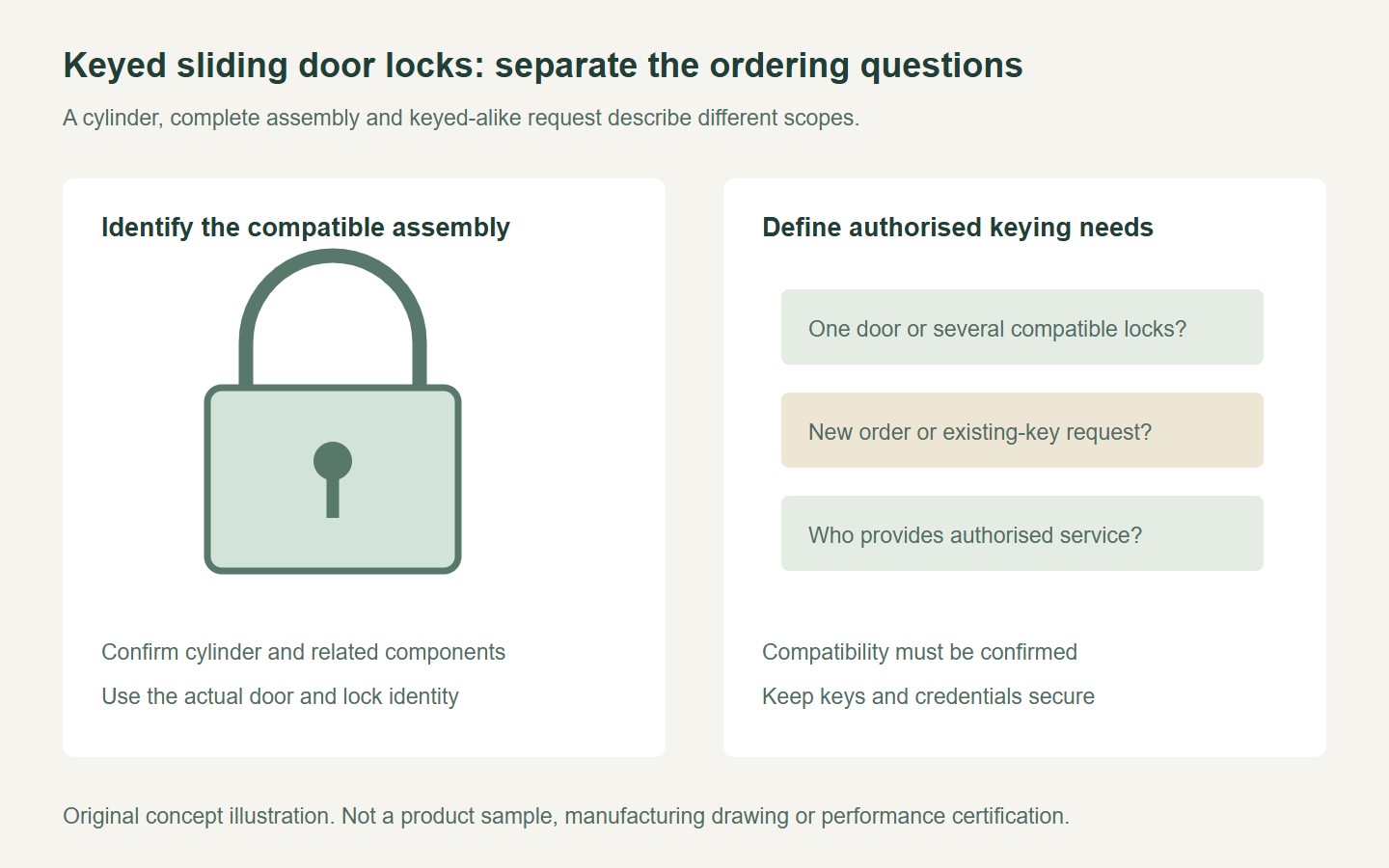
Preserve required exit access and a usable household routine
Have any required exit function reviewed before changing the locking arrangement. Do not block an opening with an improvised barrier that conflicts with its actual required use.
Ensure authorised users understand the normal operation of the selected system. Consider the complete inside approach and ability to use the door when needed, rather than judging security only by how many devices are attached.
If a particular security performance is required, request evidence for an appropriate complete assembly. A lockable door or substantial-looking accessory does not independently establish every protective result.
Keep keys, product instructions and service information managed appropriately for the actual household and system. Use the manufacturer's authorised operation rather than a workaround for a faulty component.
Maintain the door and reassess changes in operation
Follow the actual care guidance for the frame, track, seals and hardware. Preserve required drainage and service access while keeping the normal movement area clear.
If closing or locking changes, document when it occurs and arrange assessment. Do not increase force, remove parts or alter the movement path as a way to avoid resolving the cause.
After service or installation of a compatible option, obtain a demonstration of normal inside locking, authorised opening and unlocked travel. Retain the exact component references.
- Identify and use the intended primary locking sequence.
- Review the complete assembly's condition.
- Confirm any supplementary option is compatible.
- Preserve required exit and authorised access.
- Maintain the system and use its service process.
For a supplied Forge door, send the model or order details when asking about inside locking options. A suitable assessed arrangement is more useful than a generic modification applied to an unknown glazed opening.
Questions buyers ask
What is the first step for securing a slider from inside?
Close the operating panel fully and engage the intended primary lock according to the actual product instructions. If it does not engage normally, have the door and locking arrangement assessed rather than forcing it.
Can I use any auxiliary lock or bar?
Do not assume suitability. Confirm the actual door compatibility, preparation and required access functions with the manufacturer or a qualified installer. Avoid improvised barriers that prevent a required exit from being used.
Will an extra lock solve a damaged or misaligned door?
Not necessarily. The underlying condition should be assessed and repaired appropriately. Supplementary hardware should work within a suitable complete assembly, not conceal a primary closing or locking problem.
Prepared for Forge Windows and Doors (FoShan) Co., Ltd. Sources checked . Catalogue photographs and planning illustrations do not establish the performance of a supplied product.


