
Mid century modern barn doors can be approached through proportion, material contrast and the relationship between rooms. Start with a restrained face and a clear role for the wood, colour or glazing, then coordinate the visible track and handles. A style label alone does not establish a historic design or a particular construction.
For homeowners adding a new door to a modern-inspired interior, the useful goal is a coherent room composition. A contemporary product can respond to that setting without being presented as an original period object or an exact architectural replica.
Design brief: define the face rhythm, materials and room relationship, then test the open and closed layout with the actual hardware.
Use historical context without claiming a replica
Getty describes the Eames House approach to environmental control through elements including draperies, windows and sliding doors. That context shows the relationship between the opening and the way a house is used; it does not specify a new barn-door product.
When working in a significant existing building, distinguish a new inspired addition from conservation of original fabric. Have the relevant design or conservation review determine how a change should relate to the setting.
For an ordinary new interior, identify the features you want to borrow in a general design sense, such as a quiet plane, linear rhythm or deliberate contrast. Avoid attaching an architect's name to a new design without a verified basis.
Keep the brief about the actual room and product rather than relying on a historical label to make the selection.
Choose a restrained face composition
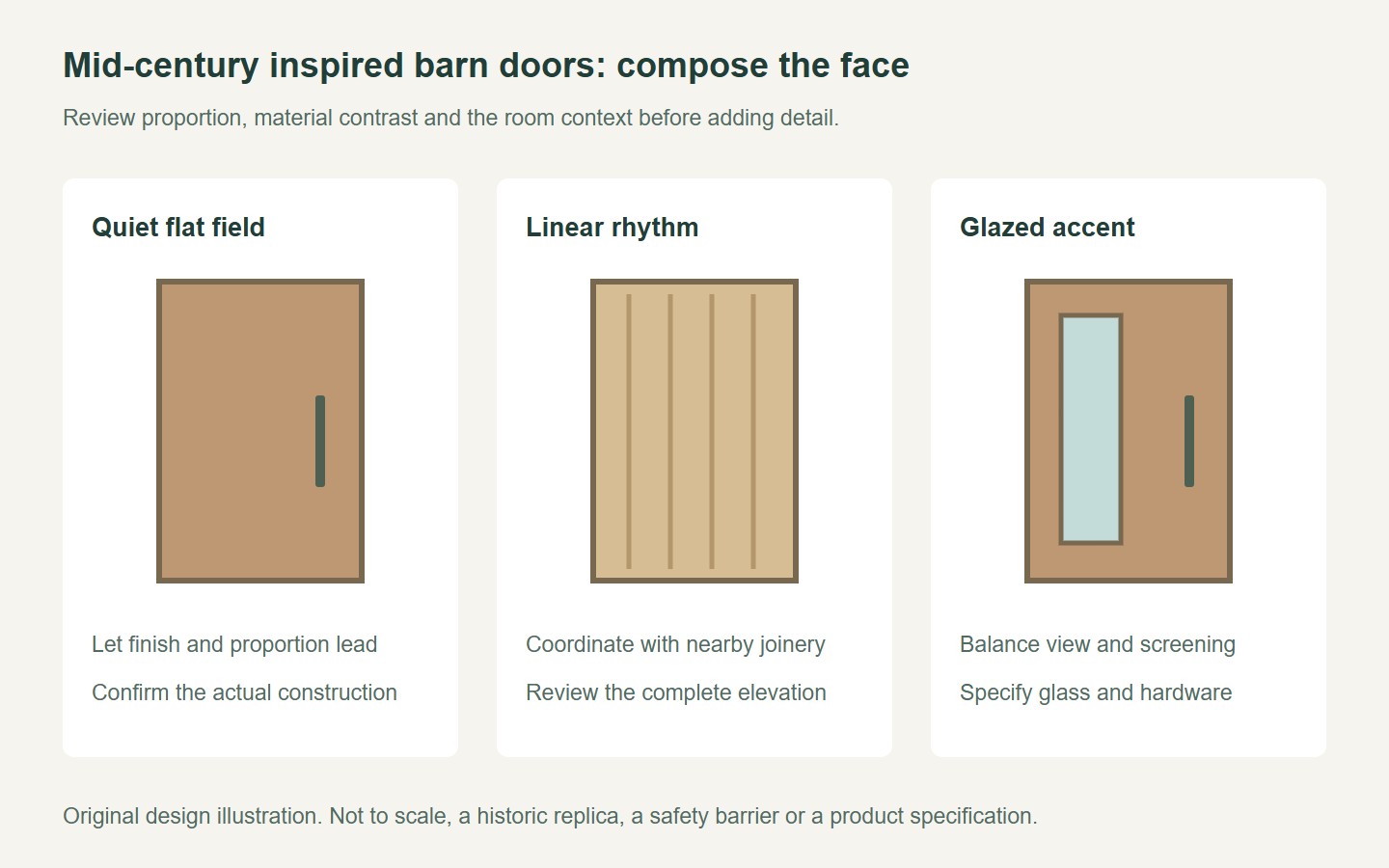
Compare a plain face, a simple sequence of vertical divisions or a defined glazed accent. Decide which material or detail should carry the design before adding several competing patterns.
Rustica published its Palm Springs barn-door design as a mid-century-inspired example. That 2018 design article is an attributed commercial example, not evidence that the same product is currently available in every size or market.
| Design approach | Question for the room |
|---|---|
| Plain face | Can proportion and finish provide enough character? |
| Linear divisions | Do the lines relate to nearby joinery and architecture? |
| Glazed accent | What view or screening effect is intended? |
| Material contrast | Which element should be the main visual feature? |
Review the full elevation, not only a small detail photograph. The same pattern can look different when scaled to the actual leaf.
Approve materials with real samples
Identify the actual leaf construction behind the surface. A wood appearance may come from different builds, and the supplier should state the material, faces and edge treatment.
Place samples beside flooring, furniture and wall finishes under the lighting used in the room. Check the reverse face where it will be visible from the adjacent space.
For a glazed accent, confirm the actual glass and desired view rather than assuming a narrow panel automatically provides privacy. Coordinate the glazing and hardware preparation before manufacture.
Let the operating hardware support the composition
Include the track, hangers and handles in the elevation. Decide whether they should remain a visible design feature or be part of a more concealed product arrangement.
The Johnson wall-mount sliding hardware range provides identified systems with their own requirements. Choose the actual hardware around the completed leaf and supporting opening, not only the desired visual weight.
Check that the handle is usable from both sides and in the parked position. A minimal-looking pull should not become difficult to reach or interfere with nearby panels and surfaces.
Review the open composition as well as the closed one. A surface-mounted leaf can cover a wall feature when parked, while its pattern may be seen alongside different furniture in the two positions.
Keep the style and room function aligned
State the privacy, passage and maintenance needs for the opening. The desired appearance should be evaluated with those requirements rather than allowed to replace them.
Ask the supplier to document the final construction, finish references and hardware in the quotation. Identify any difference between the design study and the offered assembly before approving manufacture.
- Define inspired styling without an unsupported historic claim.
- Select a clear face composition.
- Approve the real materials and glazing.
- Coordinate visible hardware and parking.
- Retain the final specification and care information.
Compare the Forge sliding door options and interior glazed door example, then send the intended proportions and material brief. Mid-century-inspired styling is most useful when it becomes a coherent, practical part of the room through a clearly specified new product.
Questions buyers ask
Does mid-century styling mean the door is a historic replica?
No. A new product may use an inspired visual approach without reproducing an original period design. Describe the actual proportions and materials, and avoid attributing the design to a historic architect or building without verified evidence.
Do mid century modern barn doors have to be solid wood?
No single material is established by the style label. Identify the actual construction and choose the material combination that suits the room and required function. Confirm faces, edges, glazing and finish rather than judging the build from a wood-looking photograph.
Should the track be hidden for this style?
That is a design choice to review with the whole elevation and the available product systems. Confirm the finished leaf and supporting requirements first, then compare visible or concealed arrangements without sacrificing handle usability, clearances or service access.
Prepared for Forge Windows and Doors (FoShan) Co., Ltd. Sources checked . Catalogue photographs and planning illustrations do not establish the performance of a supplied product.


