
An old sliding glass door should be assessed by its actual condition, product identity and available support, rather than age alone. Some concerns may have a supported service solution, while others may justify a larger replacement. Establish what is wrong and which components are involved before comparing quotations.
For homeowners deciding what to do next, a clear record is more useful than guessing the door's age from its appearance. Identify accessible labels and the observed symptoms without dismantling an unfamiliar or damaged assembly.
Assessment brief: record the product, affected components and current function, then request a reasoned repair or replacement scope.
Identify the door and interpret markings carefully
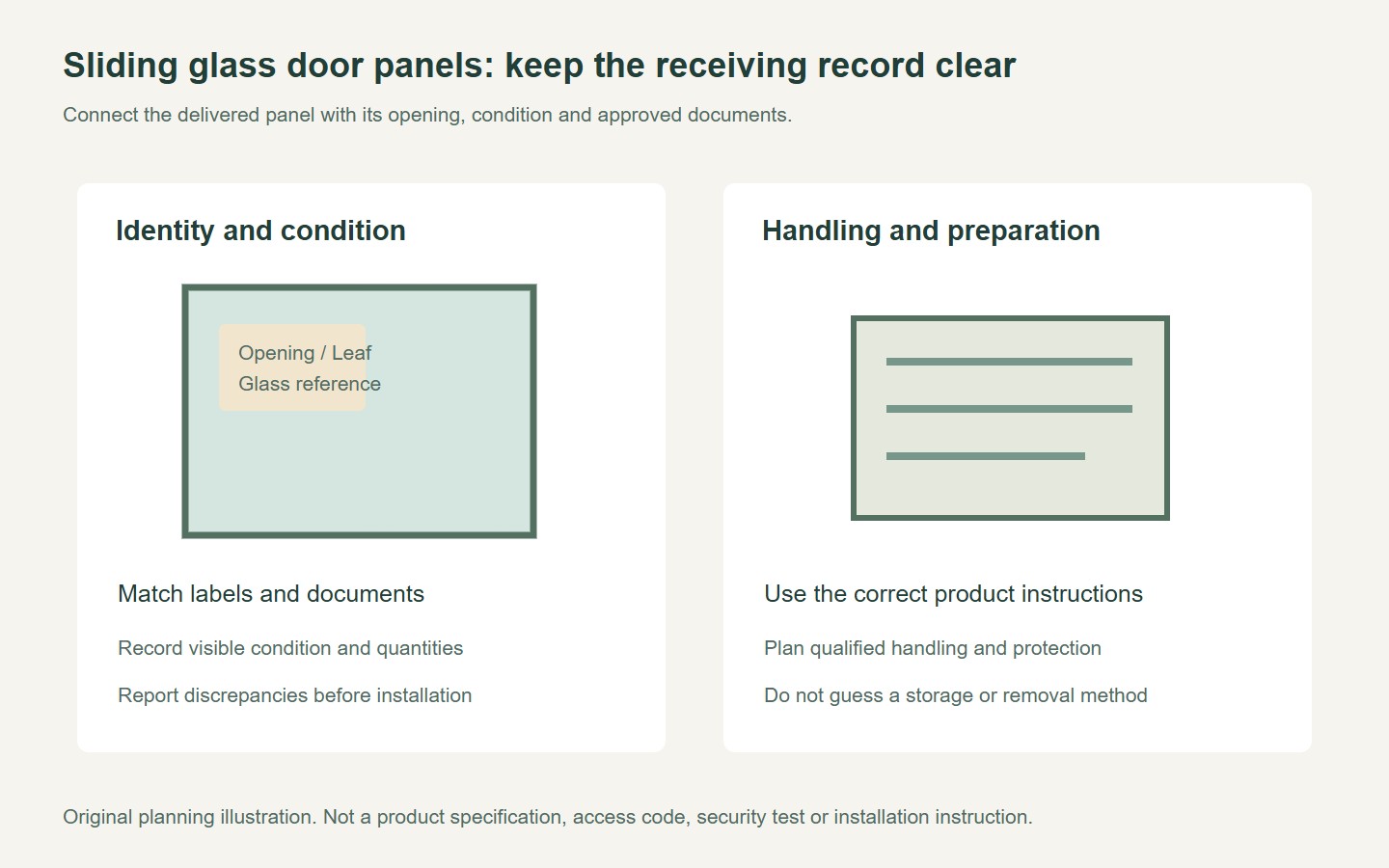
Look for accessible product labels, original paperwork and glass markings. Photograph the complete opening and connect each close-up to its position in the assembly.
Andersen explains that an etched glass logo identifies glass information rather than every feature of the complete door. A glass date should not automatically be treated as the installation date of the whole assembly, especially if components may have been changed.
Ask the relevant manufacturer or service provider to interpret the identifiers for the actual product. A similar frame shape or handle finish is not sufficient evidence of interchangeable parts.
Keep the information in one record. Even if the exact series remains uncertain, an organised set of photographs and observations gives the provider a better starting point than an unsupported age estimate.
Separate observations from a diagnosis
Record what happens during normal use: where movement is difficult, which component appears damaged and whether a concern changes with conditions. Avoid assigning a cause from a short description alone.
For glazing, note whether moisture is on an accessible surface or appears between panes. For hardware, describe the observed operation without removing or modifying unfamiliar parts.
| Observation area | Information to provide |
|---|---|
| Glass | Visible condition and location of any haze or damage |
| Frame and sill | Accessible condition, relevant leaks or finish concerns |
| Movement | When and where the normal operation is affected |
| Locks and handles | Actual component identity and observed function |
If glass is broken or a panel appears unstable, keep people away and arrange qualified assessment. Do not continue moving it simply to reproduce the symptom.
Check the supported maintenance and repair route
Andersen provides care and maintenance guides for identified window and patio-door products. Use the corresponding guidance for the actual manufacturer and assembly rather than a generic online cleaning or adjustment method.
Ask a qualified provider whether the concern can be addressed through supported service parts and work. Confirm the identity and availability of the proposed component rather than choosing a visually similar substitute.
Keep routine care separate from repairs that need a professional. The fact that a door is older does not make every adjustment suitable for a homeowner, nor does it prove that no service route remains.
If a part is unavailable, ask the provider to explain the consequence for the repair scope. Record the compatible alternatives considered before deciding that the complete assembly must change.
Compare repair and replacement on equivalent terms
A repair quotation should identify the components and work involved. A replacement proposal should identify the new assembly and any removal, preparation, fitting and making good.
The Federal Trade Commission recommends written estimates with work, materials, timing and price stated. Use that structure to understand the options rather than comparing a parts-only figure with an installed replacement total.
Ask why the provider recommends its scope and which existing components would remain. Include the support expected after the work, especially if the repair retains much of the original assembly.
Consider the required function and available evidence for the opening. If performance, use or configuration needs have changed, discuss them explicitly rather than assuming age alone should decide the choice.
Keep a record of the final decision
Retain the assessment, quotation, product references and agreed changes together. Note who verified the final measurements or parts and who accepts responsibility for the work.
After service or replacement, ask for the relevant operating and care information and a normal-use demonstration. Record the actual installed components so that future enquiries do not depend only on the door's original identity.
- Identify the product and interpret markings accurately.
- Record symptoms without guessing their cause.
- Check the supported service route.
- Compare complete repair and replacement scopes.
- Retain the decision and installed-product records.
For a door originally supplied by Forge, send the original order and observed concerns for review. If a new assembly is being considered, compare the sliding door catalogue. An old sliding glass door deserves a condition-based decision tied to the actual product and its support.
Questions buyers ask
Does an old sliding door always need complete replacement?
No conclusion follows from age alone. Identify the product, have the actual concerns assessed and check whether supported repair parts and work are available. Compare the complete repair and replacement scopes against the opening function and current condition.
Does the date on the glass tell me when the door was installed?
Not necessarily. Glass markings can identify glass manufacturing information, and components may have been replaced. Use the manufacturer guidance and original records to interpret the identifiers rather than treating an etched date as proof of the whole installation date.
What is the best first step when an older door is difficult to move?
Record the product identity and when the problem occurs, then arrange appropriate assessment using the relevant service route. Do not force a damaged or unstable assembly or apply a generic adjustment procedure to unidentified hardware.
Prepared for Forge Windows and Doors (FoShan) Co., Ltd. Sources checked . Catalogue photographs and planning illustrations do not establish the performance of a supplied product.


