
Pocket sliding doors move into a compartment within the adjoining wall when opened. They can free the wall surface beside a doorway, but their success depends on planning the cavity, support and hardware before the wall is finished. An existing opening alone does not establish whether a pocket system will fit.
For a renovation, start with the wall investigation. For a new partition, coordinate the pocket with the room plan and services from the outset. In both cases, the frame, leaf and finishes should be specified as a compatible arrangement.
Before buying: confirm the wall construction, available cavity length, finished floor level and access to the mechanism. Then check the usable opening and how the door will be pulled out of its pocket.
Treat the cavity as part of the doorway
A pocket is a working space, not spare wall space. The moving leaf needs a clear route, while the frame and support must suit the selected system. Electrical fittings, plumbing and projecting fixings can conflict with that route if they are planned independently.
Have the responsible professional establish the existing wall construction before opening it or changing its framing. The investigation should identify relevant services and any structural work. A decorative drawing that shows a disappearing door is not enough to approve alterations to a wall.
Johnson Hardware describes its 1500HD pocket frame for specified prepared wall constructions and door limits. Its published scope also distinguishes the frame kit from items such as the leaf and selected accessories. This is a manufacturer-specific example of why the kit name alone is not a complete order.
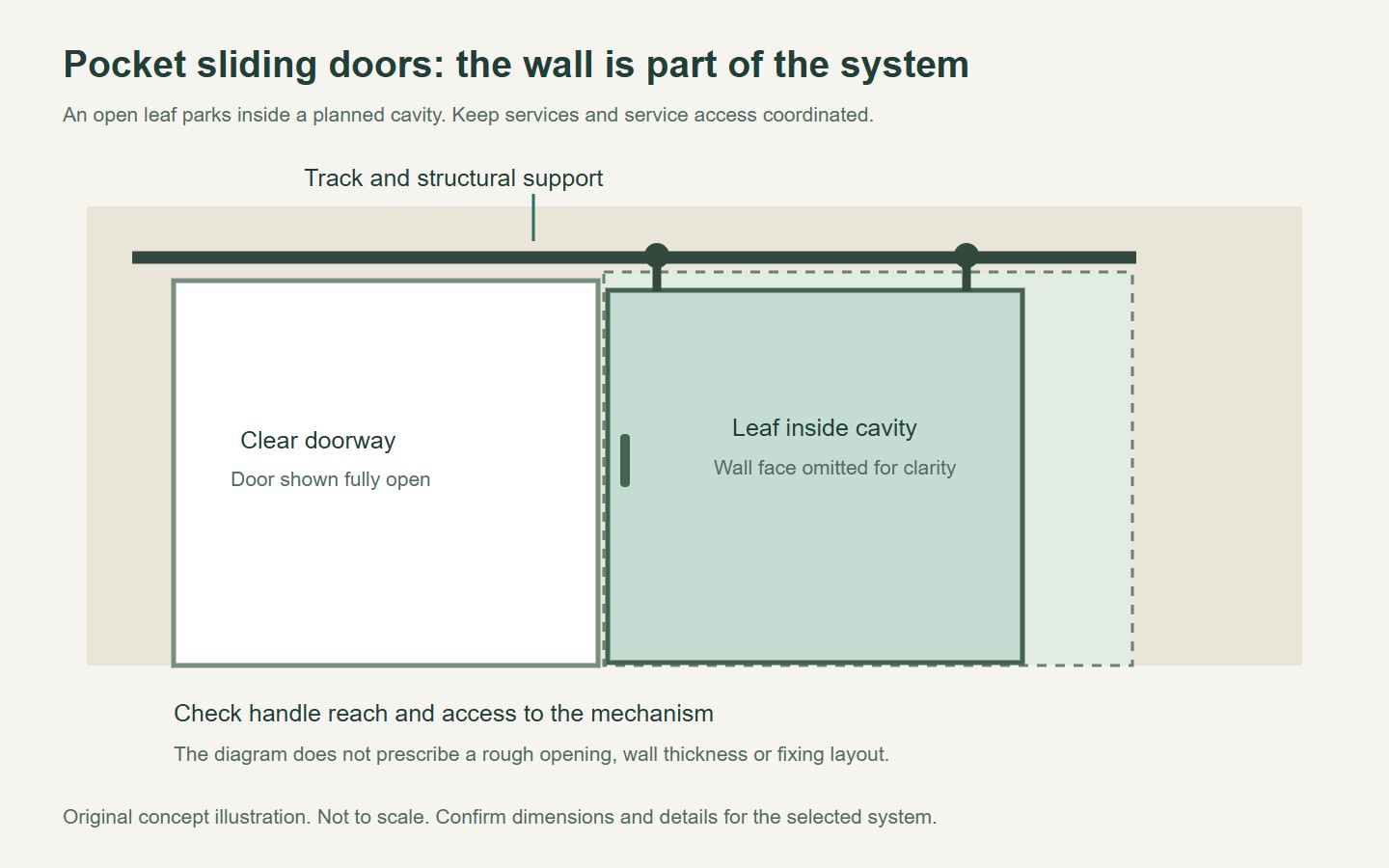
Coordinate pocket sliding doors with finished surfaces
Record the finished floor level on the door drawing. Flooring installed after the frame can change the relationship between the leaf, guide and passage. Tell the supplier about the intended build-up rather than measuring only from an unfinished slab.
Confirm the overall wall thickness, including finishes, and the leaf's finished thickness. Applied mouldings or projecting fittings can matter inside a confined cavity. Ask which leaf constructions and hardware options the frame manufacturer permits.
| Detail | Question to resolve before finishes |
|---|---|
| Wall and cavity | Is the complete frame compatible with the actual construction? |
| Finished floor | Which level controls the leaf and guide dimensions? |
| Leaf and fittings | Do thickness, weight and projections suit the system? |
| Jambs and trim | Which parts remain removable for service? |
Keep these decisions on one coordinated revision. A later change to floor finish or door construction should trigger a review before manufacture, not an improvised adjustment after delivery.
Check access when the leaf is fully open
Ask how the door is retrieved from the pocket. A face pull may become concealed, so the selected system may need an edge pull, a controlled stopping position or another compatible solution. Confirm the arrangement with the actual handle and leaf.
Where the ADA Standards apply, the U.S. Access Board guidance addresses clear passage and usable hardware, including the distinction between nominal door size and the accessible doorway. Have the designer apply the relevant requirements to the complete opening.
Also review privacy locking and emergency access for the intended room. A bedroom, bathroom or shared office may need different arrangements. Decide those functions before leaf preparation so the lock and pull details can be included in the order.
For daily convenience, consider the partially open position as well as the two extremes. The doorway should remain practical for ordinary trips through the room, with no need to reach into an inaccessible gap.
Set realistic expectations for privacy
A concealed operating route does not automatically make the closed doorway acoustically private. Ask how the leaf meets its jambs and floor, and whether the proposed assembly has evidence relevant to the room's requirements.
Your Home explains that sound isolation depends on complete systems and their junctions. Its residential guidance identifies openings and gaps as important considerations. A heavy leaf alone therefore should not be presented as proof of a quiet bedroom or confidential meeting room.
If the room needs a particular fire or acoustic function, have that requirement specified explicitly. A standard decorative pocket arrangement should not be substituted for a required tested assembly because it looks similar.
Discuss the trade-offs before selecting the mechanism. A surface-mounted or hinged alternative may be more appropriate where the existing wall cannot accommodate the required details or where its service requirements are difficult to meet.
Ask for a service plan with the order
Before the wall is closed, agree how the leaf and operating components can be removed or adjusted. Identify the removable trim and the access sequence in the handover information. Concealing hardware without a service method can make a small future repair unnecessarily disruptive.
- Confirm the surveyed wall and prepared opening.
- Match the frame, leaf, guides and accessories.
- Approve the finished-floor and trim details.
- Test the intended handle and locking sequence.
- Record access for adjustment and replacement parts.
If a glazed door is being considered, compare Forge sliding door options and the interior PT Door example. A catalogue product should not be assumed suitable for a wall pocket without confirmation. Send the wall section and room requirements to Forge to discuss the proposed glazed configuration.
Pocket sliding doors are a useful option when the hidden construction receives as much attention as the visible leaf. Resolve that construction before ordering, and keep its details available for the people who will install and maintain it.
Questions buyers ask
Can a pocket sliding door be added to any existing wall?
No. The wall construction, services, available space and any structural requirements need investigation. Have the responsible professional confirm that the selected pocket frame can be installed in the actual wall before ordering or altering it.
Does a pocket door disappear completely when open?
That depends on the design and hardware. Some arrangements retain a reachable part of the leaf; others use a compatible edge pull or retrieval method. Check the fully open position with the selected fittings.
How can the hardware be repaired after the wall is finished?
The system should have an agreed service method, such as removable trim or another access detail. Ask the supplier and installer to demonstrate that method and include it in the handover information.
Prepared for Forge Windows and Doors (FoShan) Co., Ltd. Sources checked . Catalogue photographs and planning illustrations do not establish the performance of a supplied product.


