
A retractable room divider should be selected by both its closed-room purpose and the space it occupies when stored. The term can describe lightweight screens, folding or accordion partitions, sliding panels and specialist systems that retract overhead. These are different product families, not interchangeable versions of one mechanism.
Start by stating the separation you need: a visual boundary, a flexible activity zone or a documented acoustic enclosure. Then identify where the divider will go when the room opens up again.
Before choosing: compare the stored footprint, complete movement area, support and operating requirements. A compact-looking result should not conceal an unsuitable installation or an impractical changeover routine.
Define the purpose of the closed divider
A visual screen may be enough to organise a background or separate activities, while a room used for private meetings may require a documented acoustic solution. Those aims should not be treated as equivalent because both use an opaque surface.
Describe the actual use and the frequency of change. A divider opened for an occasional event may be selected differently from one moved several times during an ordinary working day.
Your Home distinguishes sound isolation from the acoustic effect of finishes within a room. Use that distinction when comparing a simple screen with a complete partition system. Appearance alone does not establish separation performance.
| Required outcome | Question for selection |
|---|---|
| Visual screening | Does the material obscure the relevant sightlines? |
| Flexible activity zones | Can the divider be moved and stored conveniently? |
| Acoustic privacy | What evidence applies to the complete assembly and room? |
| A required building function | Which specifically suitable system and approvals are needed? |
Compare how a retractable room divider is stored
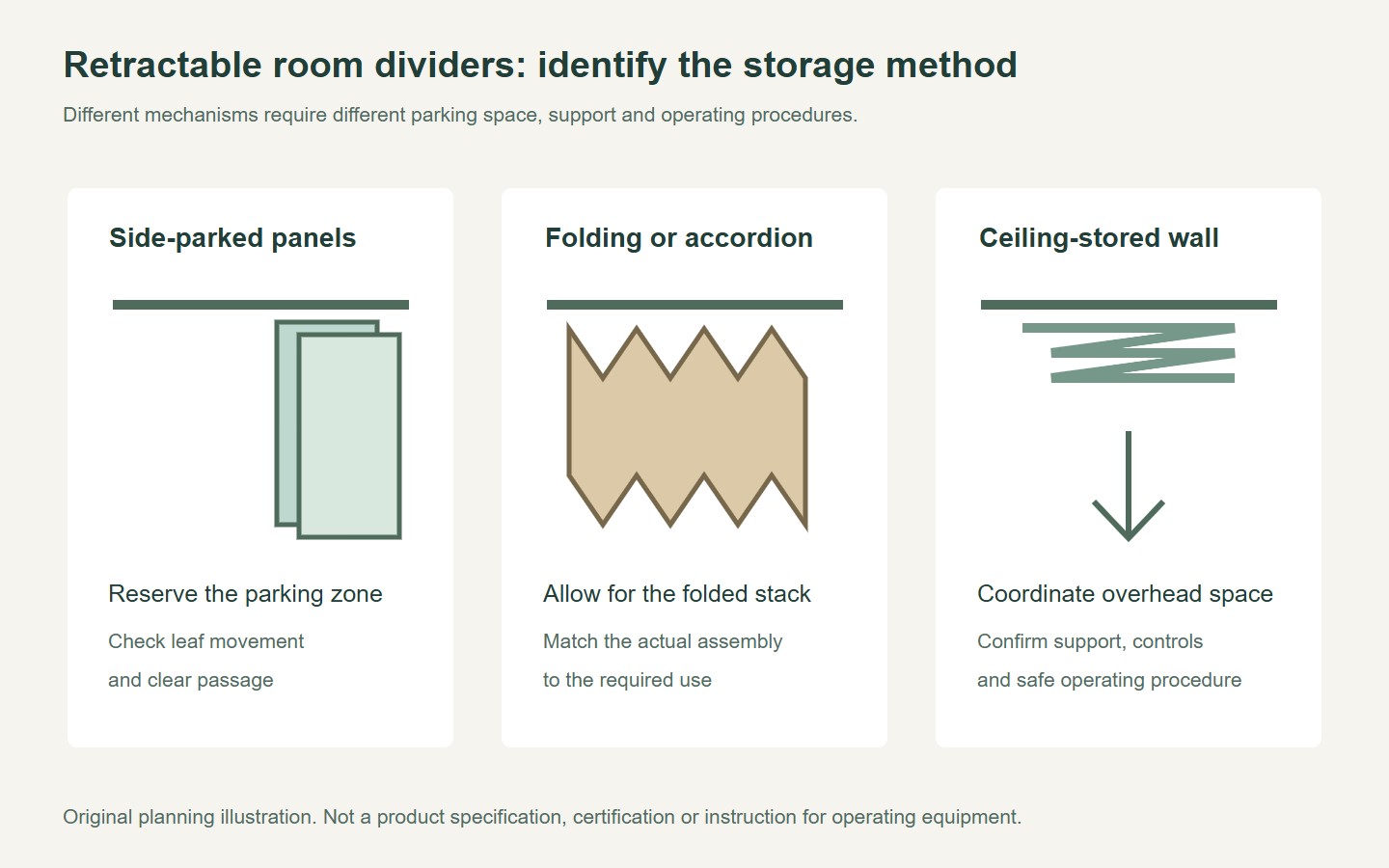
Some systems move to the side, others fold into a compact stack, and specialist arrangements store above the room. Show that storage zone on the plan or section, including the movement required to reach it.
Modernfold lists accordion, folding and other partition families, while Skyfold describes vertically folding retractable walls. These manufacturer examples illustrate different storage methods. They do not establish the capabilities of another product with the same general label.
Review the complete movement and support
Check the path of the divider as well as its final position. Furniture, lights, services and circulation may conflict with a movement area that is not obvious in a stored-state photograph.
Identify the system's support requirements and have the actual building conditions reviewed. A ceiling finish should not be assumed to carry a retracting wall, and a light-looking screen should still use its specified mounting and restraint details.
For a powered system, controls, protective features and commissioning belong to the specialist design. Staff should follow the approved operating procedure, not a generic sequence taken from another product.
Keep the movement zone managed during operation and do not bypass protective devices to save time. Any uncertainty about behaviour should be referred to the responsible service provider.
Test the room in both states
Draw the room closed and open with its normal furniture. Check passage, controls and the activities on each side of the divider. A stored stack may reduce useful wall space, while a closed partition may change access to services.
Demonstrate a representative changeover before final selection where practical. Include clearing the route, moving the divider, securing it and resetting the room. No universal operating time or staffing level is assumed here.
For acoustic or other specified performance, identify the exact assembly and configuration behind the evidence. A value for a tested partition should not be attributed to a lightweight screen or an unrelated room.
Also review cleaning and service access in the stored position. A divider that is difficult to reach for routine care can create an ongoing maintenance problem even if it looks convenient when open.
Choose a defined system and handover process
The final order should explain the construction, mounting, operating method and required documents. Identify who installs, commissions where necessary and trains the people who will use the divider.
- State the required visual or performance outcome.
- Draw the stored footprint and complete movement zone.
- Confirm the building support and service interfaces.
- Review room access in open and closed states.
- Demonstrate the intended routine and retain instructions.
- Keep the care and service contact information.
For an ordinary glazed opening, review Forge sliding door options and folding door configurations. Those catalogue links do not establish a powered overhead partition or fabric-screen range. Ask Forge to confirm the specific divider application and supply scope before ordering.
A retractable room divider is useful when its storage and operation fit the room as well as its closed appearance. Choosing the actual product family first makes the later design and maintenance decisions clearer.
Questions buyers ask
Are all retractable room dividers acoustic partitions?
No. Some provide mainly visual screening, while others are complete assemblies with specific evidence. Define the required outcome and verify the proposed system rather than inferring performance from an opaque surface.
Does overhead storage remove the need for planning space?
No. The building must accommodate the stored system, its support and movement requirements. Have the ceiling and services coordinated with the specialist supplier and responsible project professionals.
What should a changeover demonstration include?
Include preparation, the complete movement, securing the divider and returning the room to use. Confirm the intended operators, clear zones, controls and care requirements for the selected system.
Prepared for Forge Windows and Doors (FoShan) Co., Ltd. Sources checked . Catalogue photographs and planning illustrations do not establish the performance of a supplied product.


