
Sliding bedroom closet doors should make the routine of choosing and putting away clothes convenient in a furnished room. Consider which storage sections are used first, how the closet is lit and where the panels move. In a shared bedroom, those details can matter during an early start.
The useful aim is a predictable operating routine, not an unsupported promise of silent doors. Hardware, installation, storage layout and the way the leaves are used all need review.
Planning priorities: place frequent-use items behind an easy opening, keep handles reachable and confirm the selected closing options. Test the routine with the bed and nearby furniture in their normal positions.
Map the sequence of getting ready
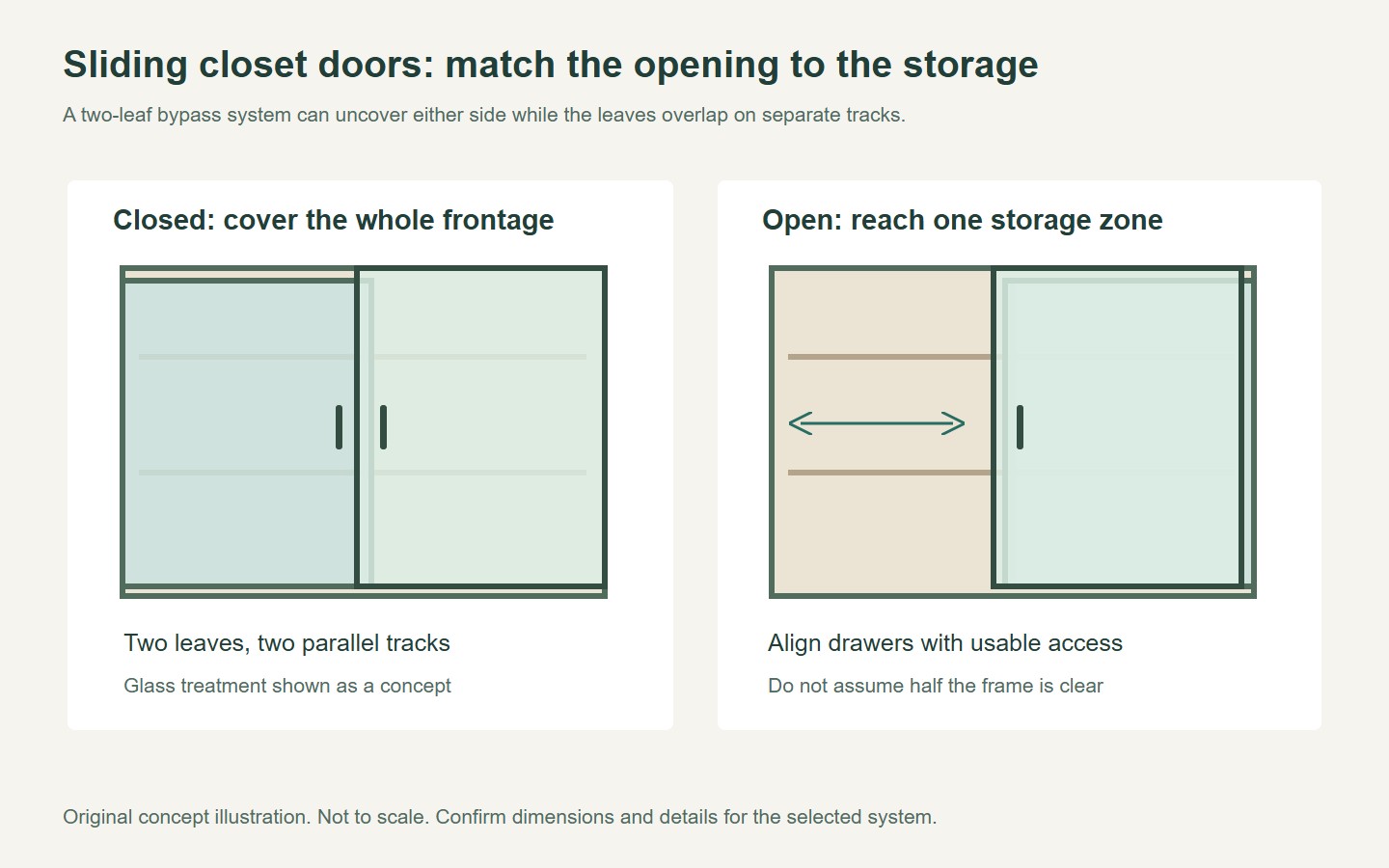
Start with the items used most often. Mark the relevant hanging rail, drawers and shelves, then identify the leaf movements needed to reach them. A storage layout that requires repeated changes of panel position may be less convenient than it first appears.
Check whether drawers can extend through the usable opening and whether the person using them has room to stand. The bed, bedside tables and a chair with clothes on it can change the available space.
| Routine step | Door and storage check |
|---|---|
| First access | The main handle and frequently used section are easy to reach |
| Using drawers | The available opening allows their full extension |
| Changing sections | Leaf movements do not conflict with furniture or the user |
| Closing the closet | The intended sequence and any accessory operate correctly |
Use this sequence to compare arrangements before selecting the decorative frontage. The access pattern should serve the routine rather than forcing the routine around the doors.
Review sliding bedroom closet doors under low-light conditions
Locate lighting controls where they can be used without unnecessary searching or movement. Check how the closet is illuminated when one leaf is open and another covers part of the frontage. The light should support the storage arrangement being chosen.
If the leaves are glazed, review how the contents and light appear from the bed. A treatment that looks suitably obscured in daylight may still show silhouettes or bright contrast at night. Test the actual sample rather than relying on a finish name.
For opaque leaves, consider where handles and edges remain visible during ordinary use. A visually minimal fitting still needs a usable grip. Confirm that it is reachable when the panel is parked.
Distinguish soft operation from a noise rating
Soft closing and soft opening describe particular stages of movement. They are not a complete acoustic rating for the closet or bedroom. Ask which features the selected system includes and the conditions under which they are compatible.
Hettich describes Silent System within its TopLine XL hardware range. The product name and feature description apply to that system; they should not be transferred to another assembly as a guaranteed noise outcome.
The Johnson Hardware 138F specification also distinguishes its basic and optional soft-operation conditions. Confirm the actual leaf thickness, weight and accessory package rather than assuming that every fitting advertised as soft-close is interchangeable.
Request a representative demonstration with the proposed leaf and hardware. Listen and observe the complete movement, but do not turn a subjective impression into an invented decibel reduction.
Address rattles through the correct service route
If an existing closet door rattles or drags, record when the problem occurs and ask the responsible supplier or installer to inspect the arrangement. The cause should be established before selecting replacement parts or changing the hardware.
Do not remove guides or stops simply to make movement easier. Use the system's care and adjustment instructions, and avoid applying a generic lubricant without confirmation of suitability.
Your Home distinguishes airborne sound from impact or structure-borne noise. That is a useful reason to describe the observed problem clearly: a knock during closing and sound passing through a room boundary are not necessarily the same issue.
Keep the hardware identification and installation record. A specific service enquiry is easier to answer than a general request to make an unknown door silent.
Approve the everyday routine at handover
At completion, walk through the normal sequence of opening, using storage and closing. Confirm that drawers, handles and lighting remain convenient with the room furnished. Have the installer demonstrate any special closing feature.
- Identify the first-used storage sections.
- Check standing space and drawer movement.
- Review lighting and glazed privacy in the evening.
- Confirm hardware and accessory compatibility.
- Keep the care instructions and service contacts.
For a related glazed arrangement, review Forge sliding door configurations and the interior PT Door example. These do not establish a wardrobe supply scope by themselves. Ask Forge to confirm the specific storage-door application before ordering.
Sliding bedroom closet doors are easier to live with when the daily sequence is planned before the frontage is approved. Practical access and clearly specified operation are more useful than an unqualified quiet label.
Questions buyers ask
Do soft-close closet doors guarantee silent operation?
No. Soft operation is a feature of a particular hardware arrangement, not a universal noise rating. Review the complete leaf, installation and routine, and request a representative demonstration.
Where should the most-used clothes be stored?
Place them where the chosen door arrangement provides convenient access with few unnecessary panel movements. Coordinate the storage layout, drawer extension and standing space with the bedroom furniture.
Should I add lubricant if a closet door becomes noisy?
Follow the instructions for the identified system and have the cause checked where necessary. Do not apply an unspecified lubricant or remove guides and stops as a general solution.
Prepared for Forge Windows and Doors (FoShan) Co., Ltd. Sources checked . Catalogue photographs and planning illustrations do not establish the performance of a supplied product.


