
A sliding door for bedroom entry should be chosen around the privacy and access the room needs when the door is closed. Review light and views around the edges, the latching arrangement and the usable passage. A space-saving movement does not automatically replace every function of the existing doorway.
This guide concerns the bedroom entrance, rather than the doors on storage within the bedroom. A closet front and a room-entry door serve different purposes and may have different project requirements.
Before choosing: define visual privacy, sound expectations and the intended operating routine separately. Have any required fire, escape or accessibility function reviewed before changing the doorway.
State what bedroom privacy means in this room
Consider who uses the adjacent space and when. A bedroom opening onto a shared corridor may need a different visual boundary from one inside a private suite. Describe the situations that matter instead of asking only for a solid-looking leaf.
Review sightlines from the corridor and from the occupied parts of the bedroom. Check the door with lights on in one space and off in the other. The centre, edges and floor gap can matter as much as the face material.
| Requirement | What to review |
|---|---|
| Visual privacy | Views through glazing and around the closed perimeter |
| Light control | Evening contrast and the gaps around the leaf |
| Sound expectations | Complete assembly and surrounding construction |
| Access and latching | Usable passage, handle reach and the required lock function |
These requirements should be part of the brief before the layout is selected. A change to one detail may affect another, so review them together.
Compare a sliding door for bedroom use in each position
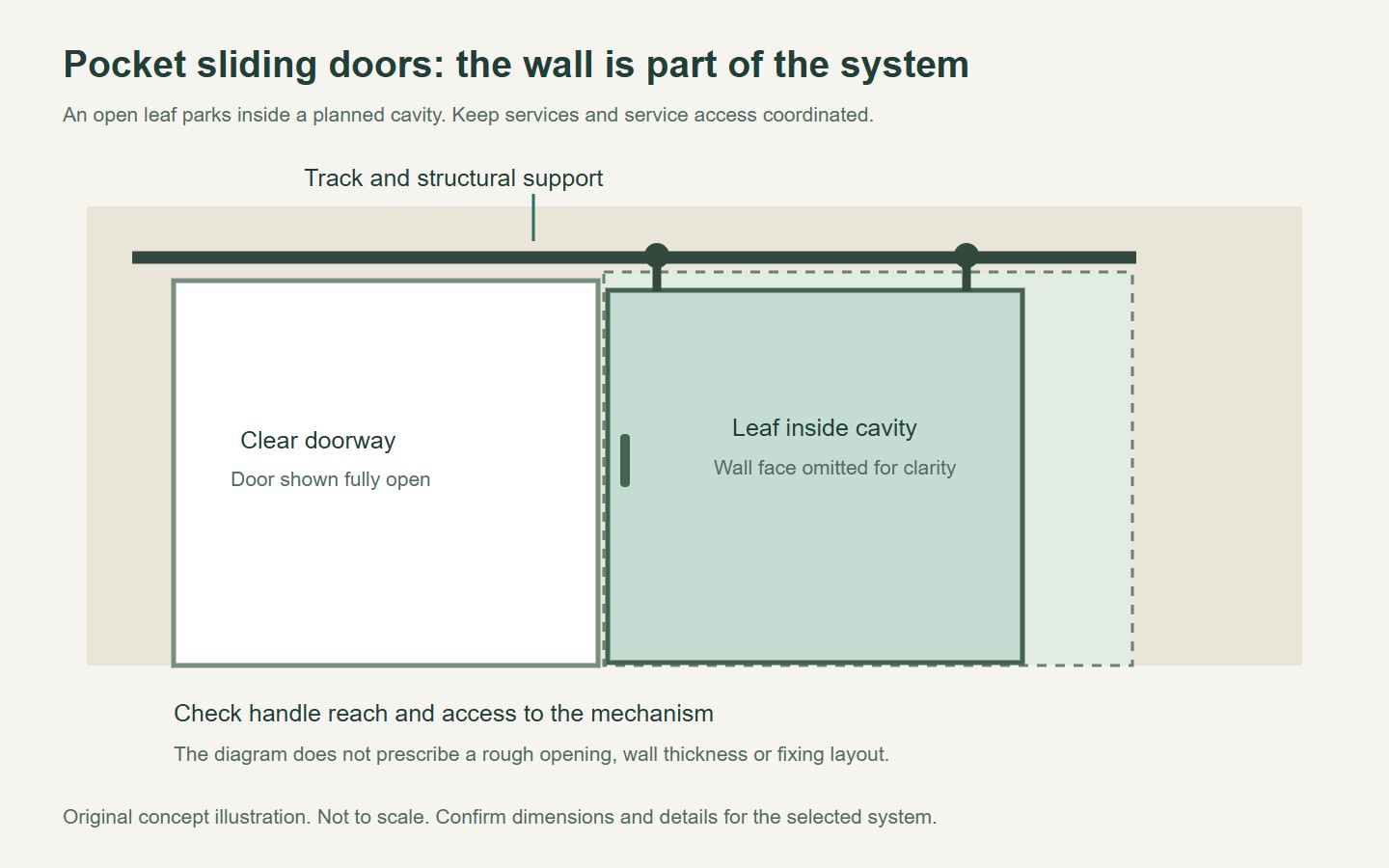
Draw the door closed, partly open and fully parked. A surface slider needs a clear wall route, while a pocket needs a suitable cavity. A bypass arrangement leaves part of the frontage occupied by the leaves.
Keep the bed, bedside furniture and storage on the drawing. Check that opening the door does not hide a needed control or obstruct a cupboard. The everyday route should remain convenient in the furnished room.
Where the ADA Standards apply, the U.S. Access Board doorway guidance considers usable passage and approach space. The relevant requirements should be applied by the project designer to the actual room and arrangement.
Separate sound isolation from the appearance of the leaf
A heavier-looking or opaque door does not by itself establish how much sound reaches the room. Ask how the closed assembly and its junctions are designed, and request evidence appropriate to any specified acoustic requirement.
Your Home explains that sound isolation depends on complete systems, including openings and gaps. It also distinguishes isolation from changes to reverberation within a room. Furnishings may affect the room's sound without proving privacy through the doorway.
Describe the concern precisely, such as conversation from a corridor or activity in the adjoining room. A useful review considers the entire path rather than selecting a door from an unsupported quiet or soundproof label.
Do not promise a decibel reduction for an unspecified bedroom assembly. If a particular result is important, have the responsible specialist identify the evidence and design needed.
Choose the material and lock function deliberately
An opaque panel, obscured glass and clear glass with another visual treatment offer different appearances. If glazing is used, test the sample in the room and confirm the applicable safety specification independently of privacy.
The CPSC architectural glazing guidance identifies door applications within its U.S. scope. Have the relevant professional confirm the requirements for the destination and supplied assembly. A frosted finish does not identify the safety classification.
Discuss the latch and any privacy lock before ordering. Confirm how the door is operated from each side and how emergency access will be handled where relevant. Avoid an improvised fitting added after the leaf is finished.
If the existing door serves a required building function, that function must remain within the design review. A decorative sliding replacement should not be assumed equivalent because it occupies the same opening.
Review the complete replacement scope
If replacing an existing doorway, identify the preparation and making-good work. Old hinges, stops or latch preparation may leave visible details, while a new pocket or support arrangement may require more extensive coordination.
- Write the room's visual, light and sound requirements.
- Compare layouts with the furniture and controls in place.
- Confirm applicable building and access requirements.
- Approve the material, handles and latching function.
- Record installation, finishing and service responsibilities.
For a related glazed configuration, review Forge sliding door options and the interior PT Door example. Send Forge the bedroom-entry plan and privacy requirements to confirm the proposed material and supply scope.
The right sliding door for bedroom entry is the one that preserves the room's necessary functions while improving its layout. Reviewing the whole doorway before selecting the finish makes that choice more dependable.
Questions buyers ask
Is a sliding bedroom entry door the same as a closet door?
No. A room-entry door controls passage and the bedroom boundary, while a closet front primarily controls storage access. Identify the intended function and applicable requirements before selecting the assembly.
Will an opaque sliding leaf stop corridor noise?
Opacity does not establish sound isolation. Review the complete assembly, perimeter details and surrounding construction. Request appropriate evidence if a particular acoustic result is required.
Can I replace the existing bedroom door without checking its function?
Do not assume a decorative replacement is equivalent. Have any required fire, escape, privacy-locking or accessibility function reviewed as part of the proposed change.
Prepared for Forge Windows and Doors (FoShan) Co., Ltd. Sources checked . Catalogue photographs and planning illustrations do not establish the performance of a supplied product.


