
Stained glass sliding doors need an artistic specification and a suitable moving-door assembly. First identify whether the design uses individual glass pieces in a supported panel, painted or coloured glass, or an applied decorative effect. The visual pattern alone does not establish safe use in a moving leaf.
For owners commissioning new work or considering reuse of an older panel, the glass specialist and door-system supplier should review the proposal together. A decorative panel made for a fixed window should not automatically be transferred into a sliding door.
Project brief: identify the construction, support the artwork appropriately and confirm the complete assembly for its intended opening.
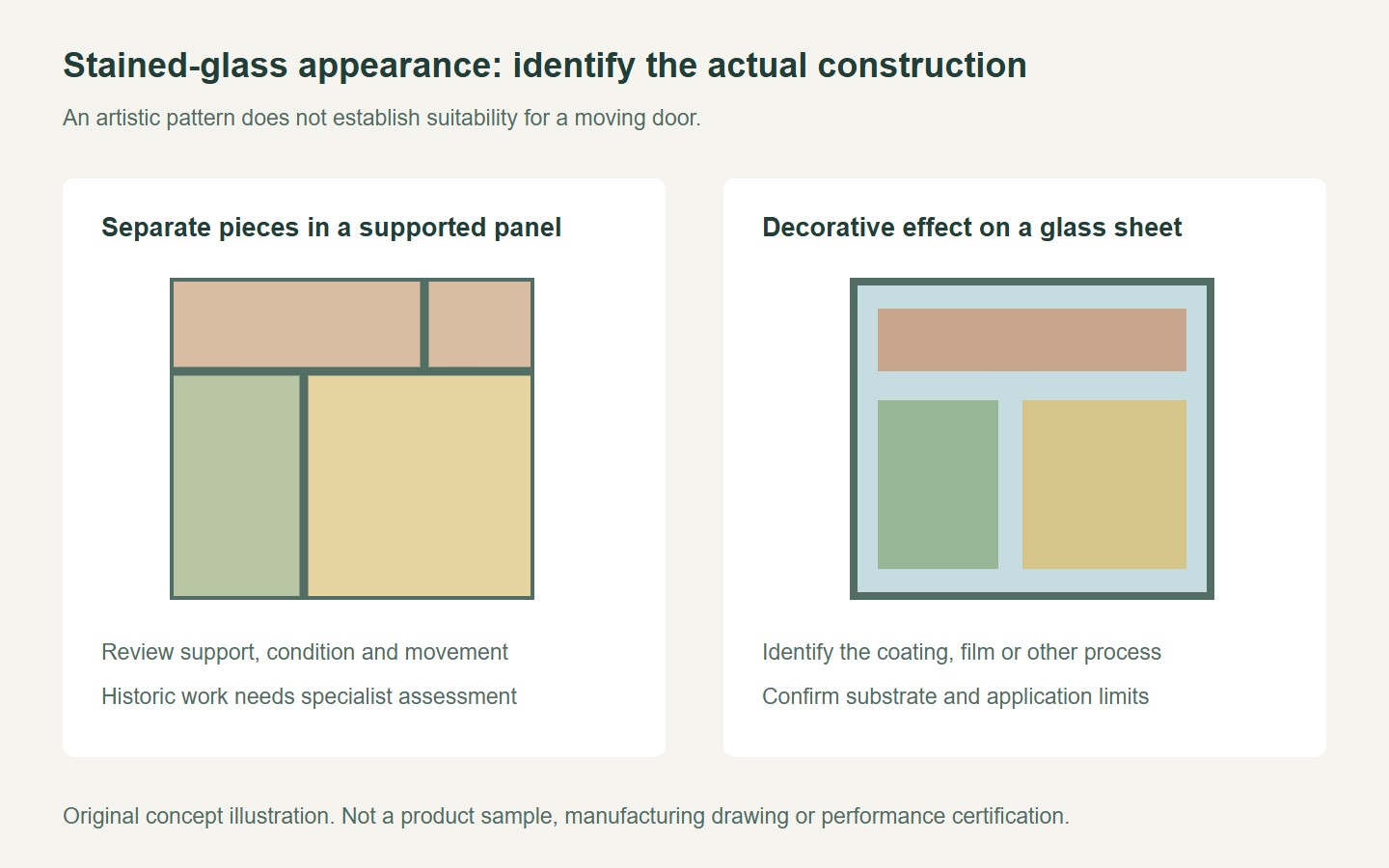
Identify what stained glass means in the proposal
The term can describe several artistic techniques. The National Park Service Preservation Brief 33 distinguishes coloured or painted glass from leaded assemblies held by metal cames. A stained-glass appearance therefore does not by itself reveal how a panel is constructed.
Ask the artist or fabricator to identify the technique and materials in the drawing. If an applied film or another decorative process creates the effect, record it accurately rather than presenting it as historic leaded craftsmanship.
| Design description | Construction question |
|---|---|
| Assembled decorative panel | How are individual pieces supported and retained? |
| Painted or coloured glass | Which glass and artistic process are specified? |
| Applied visual effect | Which product and substrate requirements apply? |
Use the answer to coordinate the door, not just to label the style. Different constructions can call for different support, preparation and maintenance.
Coordinate the artwork with a moving leaf
Have the complete finished panel weight, dimensions and edge support reviewed with the door supplier. The frame and operating hardware need to suit the actual assembly, including any protective or additional glazing proposed.
Show handle positions, panel travel and the intended stopping arrangement on the same drawing as the artwork. A fitting should not be located on an artistic element simply because it is convenient on a generic door sketch.
Ask the relevant specialists to explain how the decorative panel is retained and how service can reach it. Do not assume a piece of art glass can carry hardware loads or tolerate the movement expected from another panel construction.
Keep the approved drawing and material description linked to the quotation. Changes to glass, frame or support after artistic approval should trigger a coordinated review before manufacture.
Keep safety and protective glazing roles distinct
In the United States, CPSC identifies doors within the scope of architectural safety glazing requirements. The proposed artistic glazing and complete door must be assessed against the requirements applicable to its location and use.
Do not treat a protective outer pane as automatic evidence that the whole assembly is suitable. Its specification, retention and relationship to the artwork need to be designed and documented.
National Park Service guidance on protective glazing for stained glass explains that poorly considered protection can introduce preservation problems, including heat and moisture issues. That guidance concerns historic glazing; it is not an installation recipe for a new sliding leaf.
Ask the glass specialist and door supplier to resolve the required functions together. Decoration, impact safety, weather protection and preservation are separate questions, even when several are addressed within one assembly.
Treat historic panels as a conservation project
If the panel is old or potentially significant, document it before deciding on alteration. Record photographs, known history, dimensions and visible condition, then obtain an appropriately qualified specialist's assessment.
Preservation Brief 33 recommends professional work and documentation for stained and leaded glass. Reuse should be based on the actual panel's condition and significance, rather than assuming it can be cut down or reconfigured to fit a new opening.
Compare preservation in place or another display arrangement if a moving-door use is unsuitable. The purpose of the review is to choose a responsible use for the artwork, not to force the original panel into a predetermined mechanism.
Approve light, appearance and future care
Review the artwork from both sides and under representative lighting. A colour pattern can look different with a bright background, a dark room beyond it or artificial light reflected from the surface.
Check the composition in the closed and parked positions. Important parts of the artwork may overlap or disappear when the door moves, so the final elevation should be reviewed alongside the movement drawing.
Obtain care instructions for the artistic surface, supporting frame and operating system. Ask how damage or a loose component should be assessed, and keep the relevant specialist and supplier contacts available.
For a new glazed interpretation, review Forge sliding door options and confirm the precise artistic glass and assembly requirements. No traditional stained-glass production or historic-restoration service is assumed from a general catalogue. Stained glass sliding doors should be ordered as a coordinated art-and-door project with clear evidence for the intended use.
Questions buyers ask
Can an old stained-glass window be used in a sliding door?
Only after assessment of the panel and the proposed assembly by appropriate specialists. Its condition, significance, support and safety requirements may make that use unsuitable. Do not assume a fixed historic panel can be trimmed or fitted into a moving leaf unchanged.
Is a stained-glass effect film the same as leaded glass?
No. It is an applied decorative product with its own substrate and application requirements. A leaded assembly uses individual pieces held in a defined construction. Specify the actual technique rather than using a similar appearance as proof of identical materials.
Does adding clear glass around the artwork solve every safety issue?
Not automatically. Protective glazing, impact safety, panel support and the moving-door arrangement require coordinated review. The complete assembly must meet the requirements for its actual use, and historic work may also need a separate conservation assessment.
Prepared for Forge Windows and Doors (FoShan) Co., Ltd. Sources checked . Catalogue photographs and planning illustrations do not establish the performance of a supplied product.


