
Wall slide doors can mean leaves that travel along the face of a wall or leaves that disappear into a pocket within it. Clarify which arrangement you want before requesting a quotation. The two options use wall space differently and can require very different preparation work.
A surface slider needs a clear parking area beside the opening. A pocket arrangement needs a suitable working cavity and compatible framing. Neither should be selected from the visible doorway width alone.
First decision: identify where the open leaf will sit. Then compare the wall, services, floor and maintenance implications of the two arrangements using the same room plan.
Define the intended wall relationship
Draw the leaf in its fully open position. If it remains visible beside the opening, the wall surface becomes part of its travel area. If it is concealed, the cavity inside the wall becomes part of the operating system.
Tell the supplier which meaning you intend when using the phrase wall slide doors. A quotation for an exposed wall-mounted rail will not cover the same work as a complete pocket frame and associated finishes.
| Arrangement | Space it uses | Typical coordination question |
|---|---|---|
| Along the wall face | Clear wall beside the opening | Can furniture and controls remain outside the path? |
| Inside a wall pocket | A designed cavity within the wall | Can framing, services and maintenance access be coordinated? |
| Overlapping leaves at the opening | Parallel track depth and parked panels | How much usable passage remains? |
The third arrangement can be worth discussing when neither an exposed parking wall nor a cavity is practical. It should be compared on its actual access and space requirements.
Check the surface route against the room
For a wall-face slider, mark skirting, switches, wall lights, radiators and furniture near the opening. Include projecting handles and the depth needed to clear trim. A panel may need more separation from the wall than its front elevation suggests.
Review the route in everyday conditions. A chair pushed back from a table or an open cupboard door can enter a space that looked clear on a static plan. Keep the parking area available when the room is occupied.
The Johnson Hardware wall-mount range provides examples of system-specific leaf and fitting conditions. Match the finished leaf to the actual hardware rather than assuming that all exposed rails accept the same doors.
For a restrained appearance, discuss a covered track if the chosen system supports it. A cover changes what is visible, but it does not remove the need for suitable support or access to adjustment points.
Check the pocket route before opening the wall
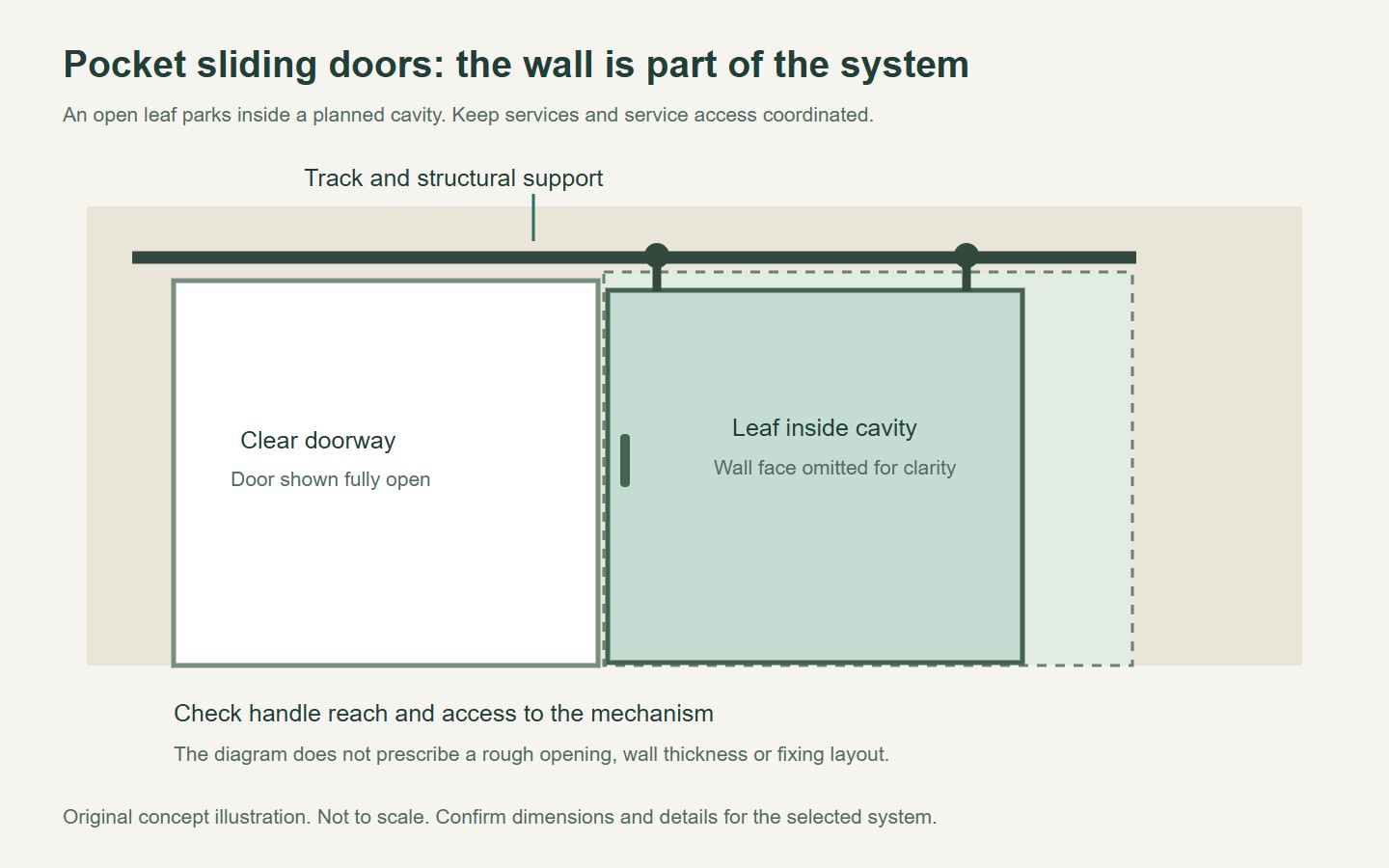
A pocket system needs more than a narrow slot. Identify the frame, cavity and support requirements, and have the actual wall construction reviewed before alteration. Existing services or structural conditions may change the feasibility and scope.
Johnson Hardware specifies prepared wall conditions for its 1500HD pocket frames. That is a reminder to use the requirements of the selected system. Do not assume that a frame intended for one construction can be inserted into another without review.
Confirm the finished wall and floor levels, and identify which trim remains removable. The service method should be part of the design before the cavity is enclosed. A concealed mechanism still needs to be maintained.
Compare wall slide doors through daily operation
Review how the user reaches the handle when the leaf is open. A pocket may conceal a face pull, while a surface slider may bring a projecting handle close to a wall. Confirm the retrieval and stopping arrangement with the selected fittings.
Also decide whether the doorway needs privacy locking or another function. Those choices can affect leaf preparation and the operating sequence. Resolve them before manufacture instead of adding a latch to a completed design without review.
The dormakaba MUTO information shows that mounting and accessory choices vary by configuration. A system that supports a particular wall, ceiling or pocket option does not establish compatibility for an unrelated product.
Compare the clear passage with the leaf parked in the everyday position. The overall opening and the usable route should appear as separate dimensions, particularly where furniture or equipment must pass through.
Compare the complete alteration scope
Ask each supplier or installer to identify preparation, support, frame work, finishing and service access in the quotation. A surface system can require work above the doorway, while a pocket may require more extensive wall coordination. The amount depends on the actual site.
Do not compare a rail-only product figure with an installed pocket system as though they were equivalent. Use the same intended doorway function and ask what additional work each option needs to provide it.
- Show where the leaf parks.
- Record the wall and floor conditions.
- Identify services and furniture that affect the route.
- Confirm handles, locks and usable passage.
- Include support, finishing and maintenance access in the scope.
Compare Forge sliding door options and the interior PT Door example where relevant. A catalogue configuration should not be assumed suitable for a pocket. Send Forge a plan and wall section to discuss the specific glazed arrangement.
Wall slide doors are easier to specify once the destination of the open leaf is clear. That simple distinction turns an ambiguous product request into a practical review of the room and its construction.
Questions buyers ask
Does a wall slide door always run outside the wall?
No. The phrase is sometimes used for both surface-mounted and pocket arrangements. State whether the open leaf should remain visible or be concealed, and request a drawing showing that position.
Which option requires less building work?
It depends on the existing wall, services, support and finishes. Compare complete installation scopes rather than assuming a product-only price represents the work needed for either arrangement.
Can the same sliding leaf be used on an exposed rail and in a pocket?
Only if the selected systems and fittings are confirmed compatible with its dimensions, thickness, weight and preparation. Do not assume interchangeability from appearance alone.
Prepared for Forge Windows and Doors (FoShan) Co., Ltd. Sources checked . Catalogue photographs and planning illustrations do not establish the performance of a supplied product.


