
A hanging sliding door carries its leaf through hardware connected to a track above the opening. The complete load path matters: leaf, hangers, rail, brackets or fixings and the supporting construction must work together. A rail with an attractive finish is not a specification for that assembly.
For buyers and renovators, the first task is to confirm the finished leaf and the actual mounting condition. The door's weight includes its construction, glazing and fittings. The wall or ceiling finish alone does not reveal what can support it.
Specification priorities: identify the leaf weight, compatible hardware, approved support and guidance arrangement. Then confirm how the system will be adjusted and serviced after the finishes are complete.
Follow the support from the leaf to the building
Ask the supplier to explain where the system carries its load. In a top-hung arrangement, the hangers transfer the leaf's weight to the track, which must be attached to suitable support. The visible cover or trim may conceal that support rather than provide it.
Have the responsible professional review the actual substrate and the selected system's fixing requirements. A generic screw size or an assumed stud position is not enough to establish suitability. Existing construction may need investigation before the order is approved.
The Johnson Hardware wall-mount range shows that mounting arrangements and leaf limits belong to specific systems. Treat a published rating as one part of a defined assembly, not as permission to fix the rail to any available surface.
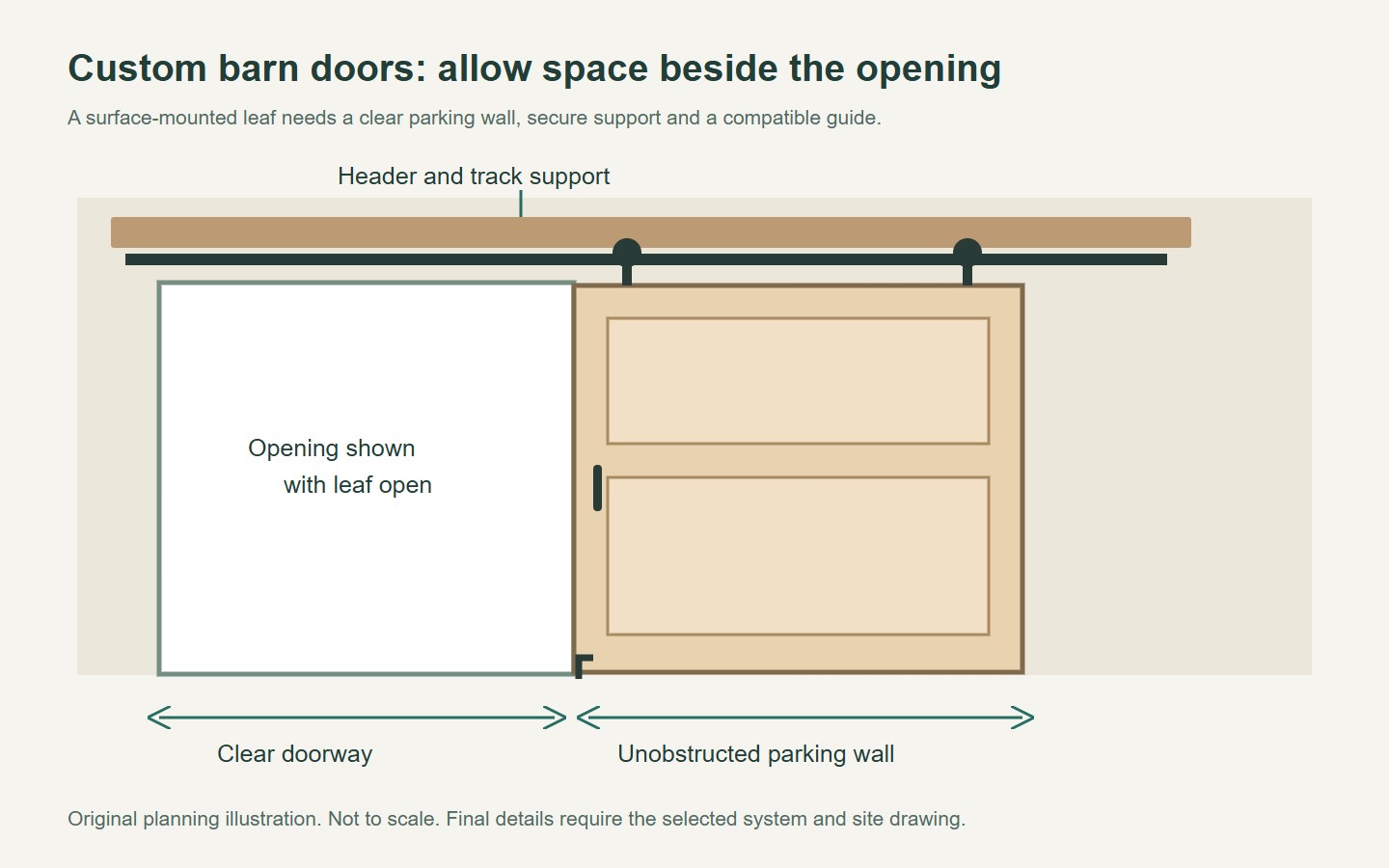
Match the hanging sliding door to its finished weight
Request the complete finished leaf weight. A bare panel may gain weight through glass, applied finishes, hardware or other additions. Confirm the final construction before selecting hangers or optional closing equipment.
The dormakaba MUTO range lists different weight classes and configuration options. This illustrates why the precise variant matters. A limit for one arrangement should not be assumed to cover a larger leaf, a different mounting method or another accessory package.
| Part of the specification | Information to confirm |
|---|---|
| Leaf | Finished weight, dimensions, thickness and fixing zones |
| Operating hardware | Exact model and compatibility with that leaf |
| Support | Required loads and fixings reviewed for the actual construction |
| Accessories | Any separate conditions for soft closing, locks or synchronisation |
Keep those confirmations on the order. A later change to the leaf or finish should prompt a compatibility review rather than being treated as purely decorative.
Understand what the floor guide does
A hanging leaf still needs control of its intended movement. Depending on the system, a guide or other restraint helps maintain its path. The absence of a continuous floor rail does not mean every floor-related component can be omitted.
Ask for the guide detail and the intended floor relationship. It should remain compatible through the full travel and work with the finished surface. Identify any services or restrictions that affect the proposed fixing location.
Stops and retention features also belong to the selected system. Do not remove them to gain a little more travel or to make the hardware less visible. Have the supplier explain any proposed adjustment within the approved instructions.
For ordinary passage, check that the guide and threshold details do not create an avoidable obstruction. Where access requirements apply, coordinate them with the relevant doorway and floor-transition provisions through the project designer.
Review soft closing and the usable travel
A soft-close fitting may have conditions separate from the basic carrying hardware. Ask about the permitted leaf weight, dimensions and space required for the mechanism. An accessory should not be added solely because it appears to attach to the same rail.
Check the movement from fully closed to fully open. Stops, handles and optional fittings can affect the final position. Request a clear-passage dimension with the actual accessories included.
Try the handle in the parked position as well as when the door is closed. A projecting pull may limit movement against a wall, while a recessed fitting may be difficult to reach if it disappears behind another leaf.
The operating demonstration should use the specified arrangement. A small lightweight showroom panel cannot, by itself, establish how a substantially different ordered leaf will feel.
Leave a practical route for maintenance
Concealed tracks can provide a restrained appearance, but their covers and adjacent finishes need a service plan. Identify what can be removed to reach adjustments or replace a component. Resolve that access before closing the wall or ceiling.
At handover, retain the system identification, drawings and care instructions. Ask who is responsible for adjustments and how a future repair should be requested. Use the supplier's maintenance recommendations instead of adding an unspecified lubricant.
- Confirm the finished leaf and its compatible hardware.
- Review the support and fixings with the responsible professional.
- Coordinate guidance, retention and stops.
- Check the complete travel with all accessories.
- Record service access and operating instructions.
Explore Forge sliding door configurations and the interior PT Door example as relevant to the intended opening. Provide Forge with the leaf, opening and mounting requirements before selecting a final arrangement.
A hanging sliding door is a complete supported mechanism. Choosing each part around that fact helps avoid a purchase based on an isolated rail rating or a photograph of concealed hardware.
Questions buyers ask
Can a hanging sliding door be fixed to a ceiling finish?
Do not assume the finish provides structural support. The selected hardware requirements and actual construction must be reviewed by the responsible professional. The visible trim and the load-bearing support may be different elements.
Does top-hung mean no floor guide is needed?
Not necessarily. The system may require a guide or other restraint to control the leaf. Request the actual detail and follow the manufacturer’s instructions rather than omitting a component for appearance.
Can I add soft closing to any hanging door?
Compatibility must be confirmed. The accessory may have its own weight, width and travel requirements. Ask the supplier to review the complete leaf and hardware arrangement before adding it.
Prepared for Forge Windows and Doors (FoShan) Co., Ltd. Sources checked . Catalogue photographs and planning illustrations do not establish the performance of a supplied product.


