


Send Message
Privacy statement: Your privacy is very important to Us. Our company promises not to disclose your personal information to any external company with out your explicit permission.

EN
A casement window stay is the support-and-guidance hardware that controls how a side-hinged sash opens and holds its position. It can be suitable when it is engineered for the exact frame, sash size, mass, opening direction and exposure. It is not a safe “close enough” replacement when the track, stack height, fixing pattern or rated capacity differs. For an Australian project, specify the whole window system first, then verify the stay against the supplier’s data and the project’s safety, wind, ventilation and sealing requirements.
A casement window is hinged at one vertical side and opens outwards or, less commonly, inwards. In many aluminium systems, a friction stay combines hinge, guide and support functions. Its linked arms move along a metal track as the sash opens. Controlled friction helps the sash remain at a chosen angle under normal use. Other systems use conventional hinges plus a separate stay arm.
The term therefore describes a function, not one universal product. Two stays with the same overall length can have different track profiles, stack heights, pivot geometry, load capability and fixing locations. Those differences affect sash alignment, gasket compression, operating effort and the way loads transfer into the frame.
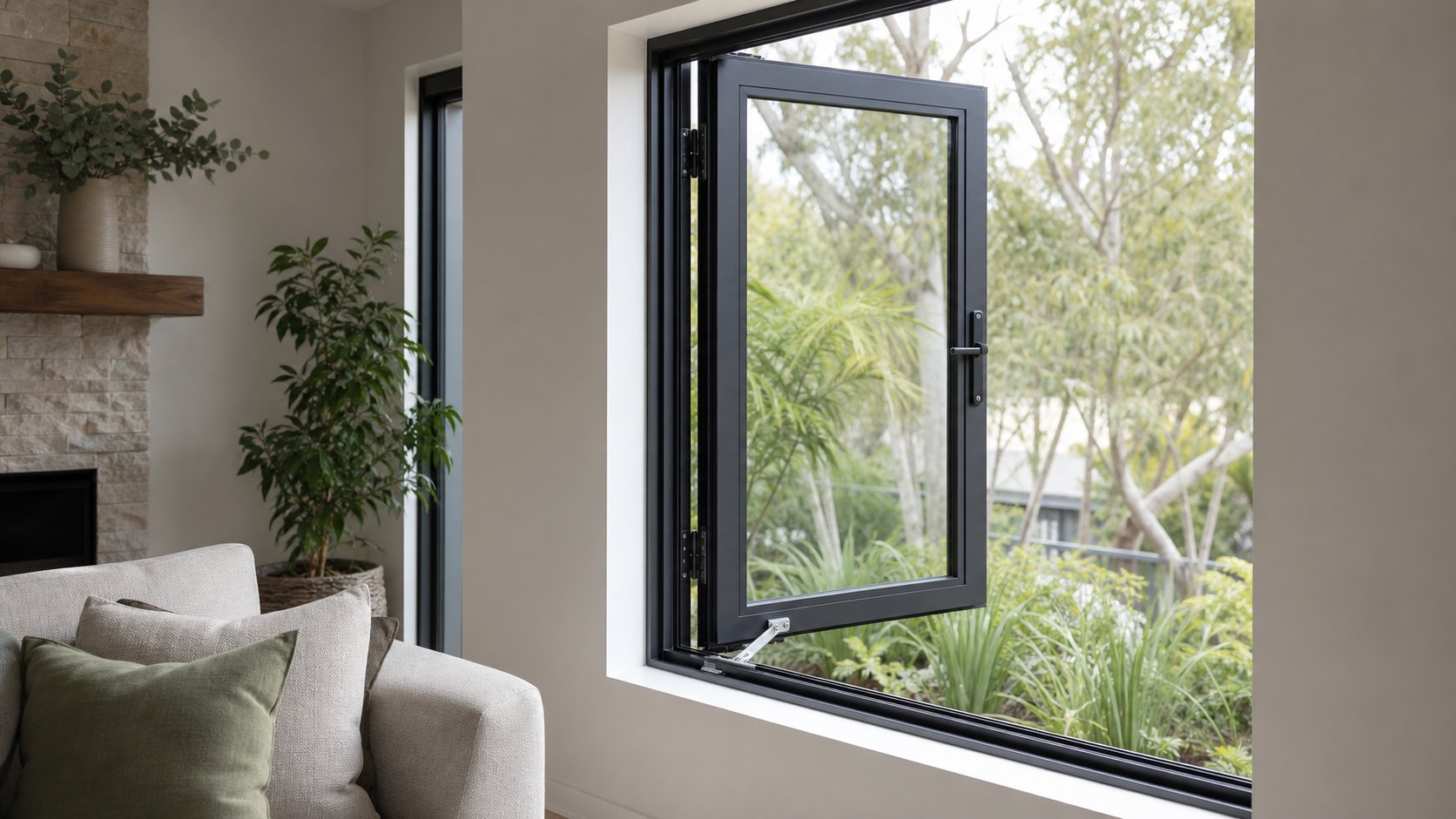
A true side-hinged casement sash stays vertical as it swings outwards; the stay must suit the sash and frame as a system.
| Component | Main job | Common symptom | Do not assume |
|---|---|---|---|
| Friction stay / stay arm | Supports and guides the open sash | Sash drops, rubs, will not hold position or moves unevenly | That a similar-looking stay has compatible geometry or capacity |
| Latch and keeper | Pulls and secures the closed sash | Handle will not engage or gasket compression is uneven | That a stronger latch can correct a misaligned or unsupported sash |
| Winder / operator | Drives controlled opening and closing | Chain, handle or gear slips or jams | That every casement window uses a separate operator |
| Opening restrictor | Limits the available opening for a defined safety purpose | Opening exceeds the intended limit | That ordinary stay friction is a compliant safety restriction |
If the sash rubs when closing, inspect the complete geometry before changing the latch. A worn or incorrectly sized stay may let the sash drop, while loose frame fixings, distorted sash members or glazing movement can create similar symptoms. Our earlier casement window guide for Australian homes explains the broader window configuration; this article focuses on the stay.
Record the frame and sash series, manufacturer reference, material and whether the sash opens inwards or outwards. Photograph the full window from inside and outside, plus both the top and bottom hardware. Do not rely on “left” or “right” alone: suppliers may describe handing from different viewpoints.
With the window made safe, record track length, closed stack height, arm layout, fixing centres and available clearance. Also record sash width, sash height, glazing build-up and the best available sash-mass information. Never remove a stay from a large or elevated sash without suitable support and a competent installer.
The stay supplier should confirm that the selected assembly suits the sash dimensions and mass, intended opening angle, installation orientation and exposure. Coastal or corrosive environments can affect material and fastener selection, but “stainless steel” alone does not prove suitability. Ask for the exact grade, component specification and maintenance guidance applicable to the project.
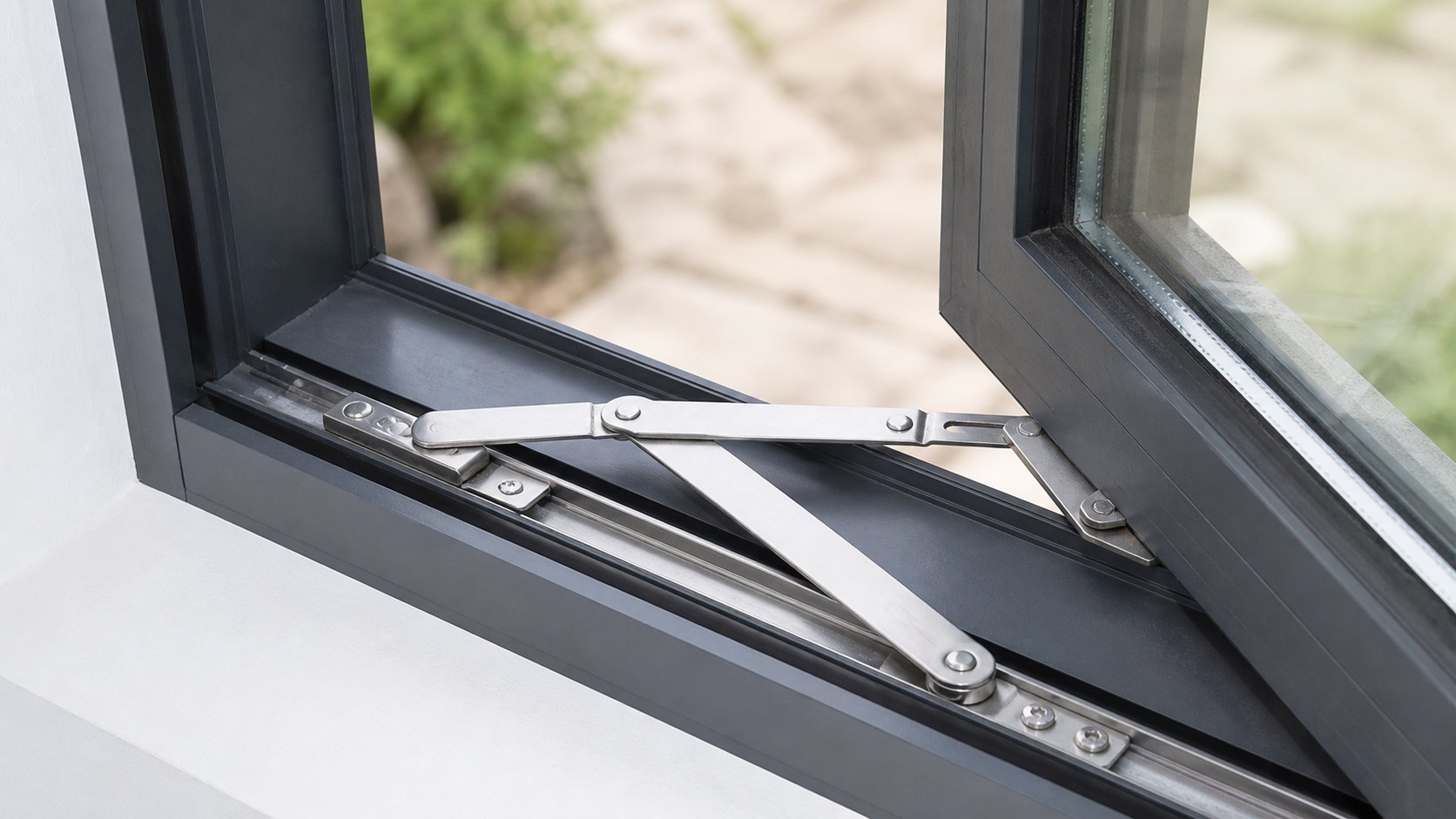
Track profile, arm geometry, pivots, sash connection and fixing positions all need to match; overall length is only one input.
A suitable stay should let the sash close squarely without forcing the handle, scraping the frame or leaving uneven gasket contact. Hardware selection affects operation, but the installed window must still be assessed as a complete assembly. The Australian Glass and Window Association explains that AS 2047 testing for applicable external windows includes operating force, air infiltration, water penetration resistance and structural tests under the AS 4420 series. That does not mean a replacement stay automatically preserves an existing window’s tested status; confirmation must come from the relevant system supplier or project professional.
A stay is not automatically an opening restrictor. The ABCB advisory note on openable windows points users to fall-protection requirements for certain windows. In the current Housing Provisions, Part 11.3 sets different triggers and protection details for bedrooms and other rooms. Requirements depend on building classification, room use, sill/opening height, fall distance, state or territory variations and the adopted NCC edition. Obtain project-specific advice rather than treating friction as a safety device.
Opening hardware also interacts with ventilation and energy performance. The NCC provisions for natural ventilation address the available openable area, while Housing Provisions Part 13.4 addresses sealing of applicable external windows and doors. A stay that changes the opening angle or prevents even gasket compression can therefore affect more than convenience. The correct solution must be checked against the building’s approved design and local regulatory pathway.
Do not lubricate a friction mechanism unless its manufacturer specifically permits it; the wrong lubricant can change holding friction or attract abrasive contamination. Likewise, do not add holes to a thin frame member without confirming the fixing method and structural implications.
Isolated stay replacement may be reasonable when the sash, frame, glazing, seals and locking hardware are serviceable and an exact approved part is available. A broader window assessment is preferable when the frame is distorted, glazing is loose, drainage paths are damaged, several components are obsolete or the required performance cannot be confirmed.
You can review Forge’s Aluminium Casement Window category and full product range for configuration ideas. These pages do not by themselves confirm that a specific stay, tested rating or compliant solution is available for an Australian project. Ask for project-level verification before specifying or purchasing.
Sometimes. A friction stay can combine hinge, guide and support functions. Other windows use separate hinges and a stay arm, so identify the actual mechanism before choosing a replacement.
No. Length is only one measurement. Track profile, stack height, arm geometry, fixing centres, handing, sash size and mass, opening angle and frame clearance also matter.
Many systems use a matched pair, and uneven wear can affect alignment. However, the correct approach depends on the window system and stay supplier. Follow their documented replacement instructions.
Not by default. Normal holding friction is not evidence of a compliant opening-restriction or barrier solution. Check the applicable NCC provisions, state or territory variations and project conditions with a qualified professional.
Provide the project location, building type and level, room use, opening sizes, drawings, sash dimensions and quantity, photos of both stays and any labels, glazing and performance targets, exposure conditions, required opening or safety outcome, and programme timing.
A casement window stay is small hardware with a large influence on alignment, operation and the usable opening. The dependable choice is the documented component that matches the frame and sash, not the closest visual substitute. Compliance and performance must be confirmed for the complete installed window and the specific Australian project.
To discuss a project, contact Forge with the project location, opening schedule or drawings, opening sizes, quantities, glazing and performance targets, hardware photos and required timing. Forge can then review the request and confirm what information or project-specific verification is still needed.
Contact me today.
Author:
Ms. Eva Li
E-mail:

November 08, 2026

November 08, 2026
Email to this supplier
Author:
Ms. Eva Li
E-mail:
November 08, 2026
November 08, 2026
Privacy statement: Your privacy is very important to Us. Our company promises not to disclose your personal information to any external company with out your explicit permission.
Fill in more information so that we can get in touch with you faster
Privacy statement: Your privacy is very important to Us. Our company promises not to disclose your personal information to any external company with out your explicit permission.